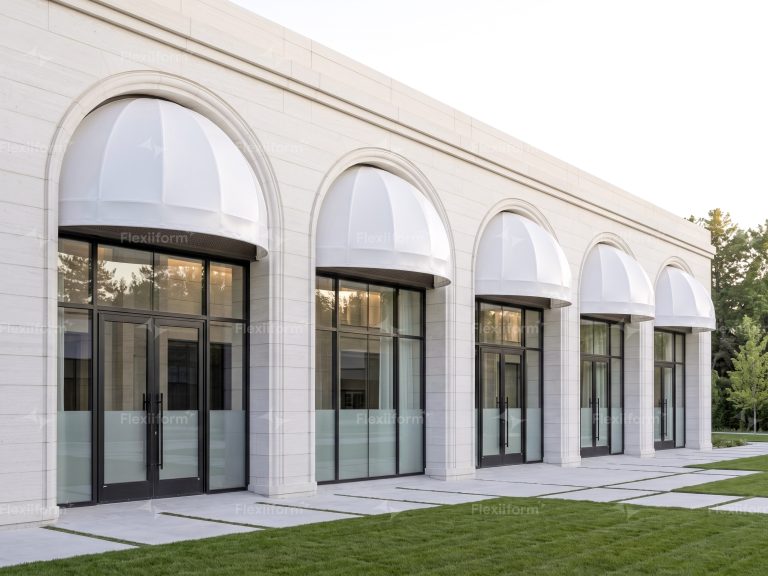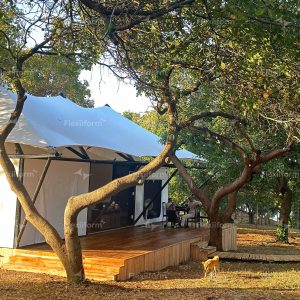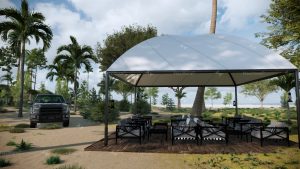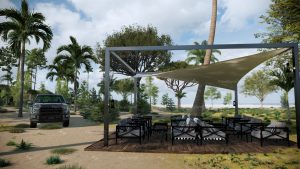
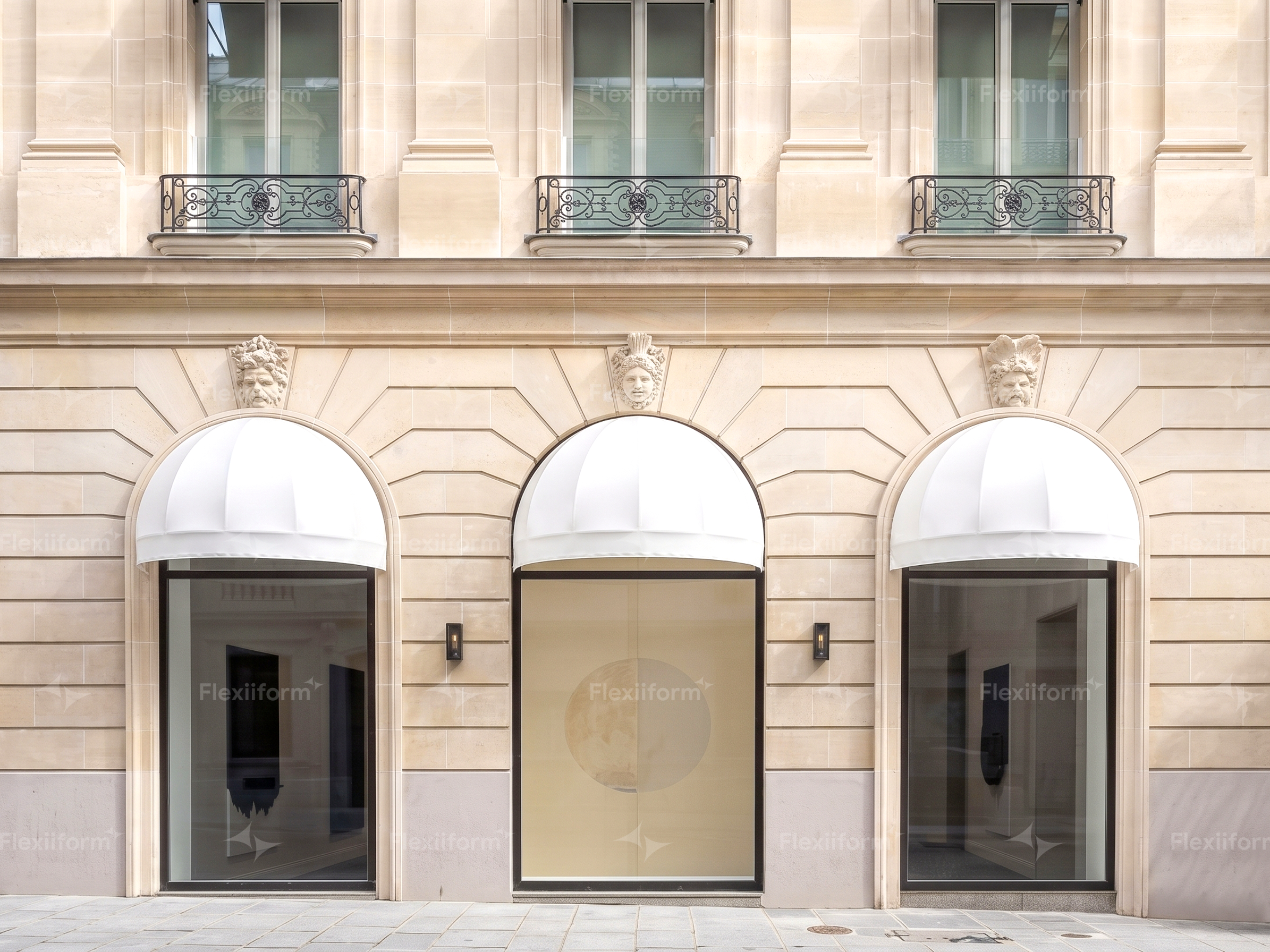
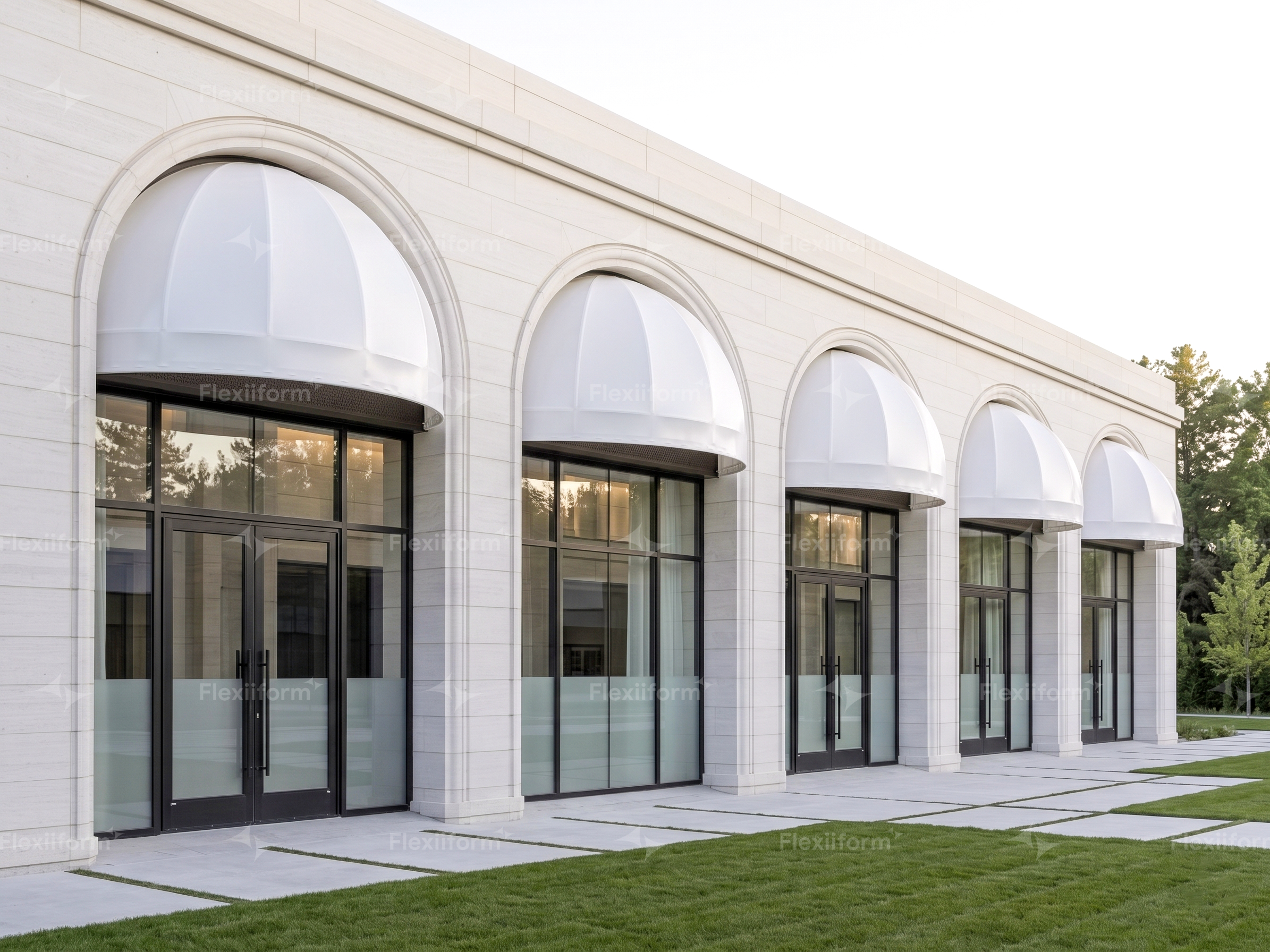
A dome awning is a fabric canopy stretched over a curved metal frame and fixed to a wall above a window, a door or an entrance. Unlike a retractable awning that rolls in and out, it is a fixed cover: it keeps its shape all year, so it works as weather protection and as a piece of the facade at the same time. The Wild Duck Canopy Module is built to the measurements of each opening, with the shape and fabric colour chosen to match the building.
This article covers the three parts of an awning, 11 standard shapes and 8 valance styles, the difference between an awning and a canopy, fixed versus retractable covers, and how to measure an opening before asking for a quote.
Quick facts about fabric awnings and canopies
- What it is a fabric cover stretched over a metal frame, fixed to the wall above an opening
- Parts the fabric cover, the structural frame and the valance
- Three measurements L is the width, W is the projection out from the wall, H is the height of the awning
- Shapes 11 standard shapes, from a flat sloping Standard to a ribbed Dome
- Valance 8 edge profiles along the bottom, and the usual place for a shop name
- Fixed, not retractable each unit is made to the measurements of one opening
- Used on storefronts, hotels and restaurants, house windows, building entrances, resort walkways, and the front porch of glamping tents and pergolas
Awning or canopy: what is the difference?
In architecture, a canopy is a roofed structure that projects from a building with open sides, used to shelter people from sun and rain and often to mark an entrance. An awning is usually the smaller version: a cover attached to the wall that shades a single window or door. A canopy may be larger and may rest on posts of its own.
In practice the two words are used interchangeably, and suppliers tend to say “awnings and canopies” as one category. What matters when you order is not the word but three things: the shape, the three measurements, and how the frame is anchored to the building.
The three parts of an awning
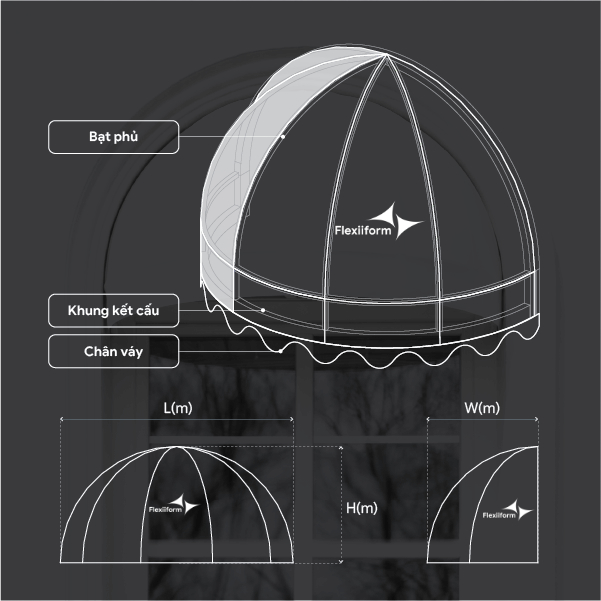
Whatever shape it takes, a fabric awning is made of three parts:
- The fabric cover: the technical fabric stretched over the frame. It takes the sun, rain and UV, and it decides the colour and the finish of the surface. The fabric is the replaceable part: when it fades after some years, it can be recovered while the frame stays in place.
- The structural frame: the metal ribs that give the awning its shape and carry the load into the wall. The frame is bolted to the facade through base plates, so the anchoring surface — brick, concrete, a steel frame or a glass curtain wall — has to be identified while measuring.
- The valance: the strip of fabric that hangs down along the front and side edges. It hides the edge of the frame, blocks some low afternoon sun, and is the usual place to print a shop name or logo.
The size of an awning is written as three figures: L for the width, W for the projection out from the wall, and H for the height from the bottom edge to the top. Those three figures plus a photo of the facade are enough for a first quote.
11 awning and canopy shapes
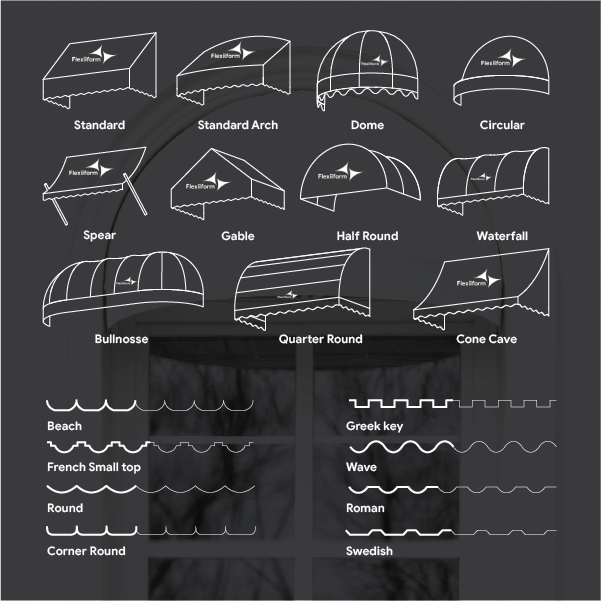
The shape decides most of how the facade will look once the awnings are up. These eleven are the shapes used most often, named as they appear on the workshop sample chart:
| Shape | Form | Typically used for |
|---|---|---|
| Standard | Flat sloping face with triangular side panels | Rectangular windows and doors, modern facades |
| Standard Arch | Like Standard, with a gently curved top edge | Rectangular openings that need a softer line |
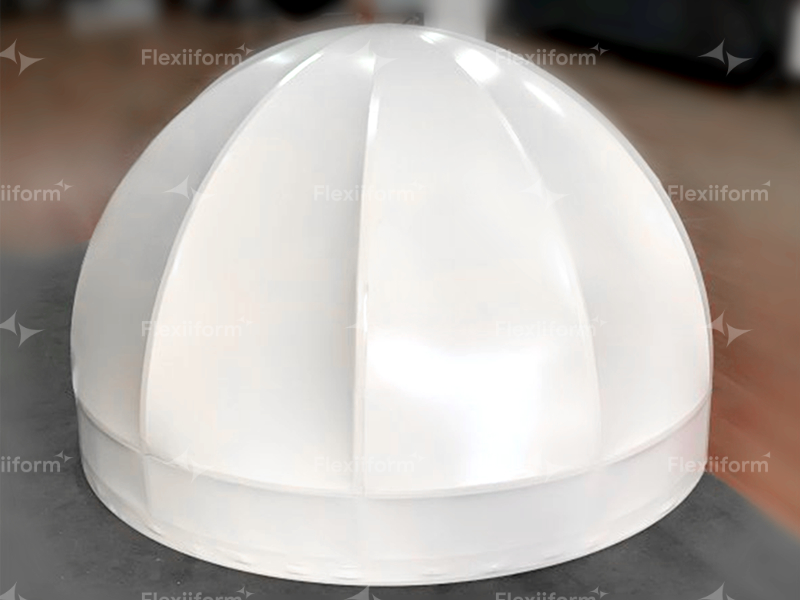
| Dome | Ribbed dome projecting like a half sphere | Arched openings, classical facades, hotel entrances |
| Circular | Smooth rounded face with no ribs | Small windows, arched openings, minimal facades |
| Spear | Sloping face carried on exposed angled support rods | Upper-floor windows, balconies, a more utilitarian look |
| Gable | Two sloping faces meeting at a ridge, like a roof | Main entrances and large doors that need emphasis |
| Half Round | Half barrel laid horizontally, cut flat at both ends | Entrance doors, sign bands |
| Waterfall | Curved face falling forward like a sheet of water | Shopfronts and showrooms |
| Bullnose | Ribbed barrel with a rounded front edge | Long window bands, facades with repeated openings |
| Quarter Round | A quarter circle, curving down to the front | Windows and facades with limited headroom |
| Concave | Fabric curving inward, tensioned like a sail | Modern facades that want a softer line |
The three rounded shapes — Dome, Circular and Half Round — are the ones seen most often on hotels and shopfronts, because their curve follows the curve of an arched opening and keeps the classical lines of the building.
8 valance styles
The valance is the fabric strip along the bottom edge. Its profile is a small detail that changes the feel of the whole facade, so it is usually chosen last, once the shape and the colour are settled:
- Soft curves: Beach, Wave, Round, Roman and French Small Top. These give a lighter line and suit cafés, fashion stores and small hotels.
- Straight and stepped edges: Greek Key, Corner Round and Swedish. Squared or rounded-corner profiles that suit modern facades and brands that want a crisp edge.
If a shop name is going on the valance, pick a profile with a long enough straight run so the lettering is not cut by the curve.
Fabric awning or rigid polycarbonate canopy?
Entrance covers also come as rigid translucent panels on an aluminium or steel frame, the type often seen over office lobbies. The two serve different needs:
- Fabric awning: a soft surface that can take curved and domed shapes, light, printable, and recoverable when the fabric ages. This is what Wild Duck builds.
- Rigid translucent canopy: a hard panel that lets daylight through, so the area underneath stays bright, but the shapes are mostly flat or simply curved and it cannot be printed the way fabric can.
Choose by the goal: shade plus a recognisable shape on the facade points to fabric; rain cover while keeping daylight below points to translucent panels.
Fixed awning vs retractable awning
| Criterion | Fixed fabric awning | Retractable awning |
|---|---|---|
| Structure | Fixed frame bolted to the wall | Rails with a hand crank or a motor |
| Appearance | Keeps its shape all year, reads as part of the facade | A flat plane when out, folded away when not in use |
| Moving parts | None | Yes, and they need servicing |
| In a storm | Carries load as the frame is engineered for it | Has to be rolled back in |
| Shapes available | Domes, barrels, gables, concave sails | Mostly one sloping plane |
| Best for | Facades that need a steady identity, arched openings, entrances | Terraces and balconies that need shade only some of the time |
Where awnings and canopies are used
- Storefronts and showrooms: shade on the glass, display goods kept out of direct sun, and a facade that is easier to pick out from down the street.
- Hotels and restaurants: one shape repeated across a row of windows gives the elevation a rhythm; at the entrance, a larger unit shelters guests getting in and out of a car.
- House and apartment windows: less afternoon sun into the room and less rain blowing through an open window.
- Resorts: extending cover over the walkways between areas, outdoor bars, and the front porch of glamping tents and pergolas. This is how the Canopy Module is used most often on Wild Duck projects.
Choosing a shape for your opening
- Arched openings: Dome, Circular or Half Round, so the curve of the awning follows the curve of the arch.
- Rectangular doors and windows: Standard, Standard Arch, Waterfall or Quarter Round.
- A main entrance that needs emphasis: a Gable, or a Dome made larger than the units beside it.
- A run of openings: keep one shape and one projection, and change only the width from bay to bay. The elevation then reads as a rhythm rather than a collection.
- Colour: white and cream keep the facade light and sit well against stone and pale render; a deep brand colour stands out more but absorbs more heat.
How to measure and order
- Measure L: the width of the opening, plus an overlap on each side so rain does not run down the edge of the frame.
- Measure W: the projection you want. A deeper projection throws shade further into the room, but check the pavement line and the clear space in front.
- Measure H: the height of the awning, limited by the blank wall between the head of the opening and whatever is above it — a cornice, a balcony or a sign band.
- Photograph the facade: one straight-on shot and one at an angle, showing the opening and the wall above it.
- Note the anchoring surface: brick, concrete, a steel frame or glass, since each is fixed differently.
- Send it to Wild Duck: the three measurements, the photos, the number of units and your brand colour. We advise on the shape and quote within 24 working hours.
Looking after a fabric awning
- Wash the fabric from time to time with water and mild soap, using a soft cloth or a soft brush; strong solvents and stiff brushes scratch the surface coating.
- After each storm season, check the bolts, base plates and wall fixings, and retighten anything that has worked loose.
- Clear leaves and debris off the top, especially on concave shapes, so water drains the way it is meant to.
- When the fabric fades or slackens after some years, recover the frame instead of replacing the whole unit.
Frequently asked questions
What is a dome awning?
A dome awning is a fabric cover stretched over a curved ribbed frame, fixed to the wall above a window, door or entrance, and projecting from the facade like a half sphere. It is made of three parts: the fabric cover, the structural frame and the valance.
What is the difference between an awning and a pergola?
A pergola is a freestanding structure with its own posts and roof, set out in a garden or on a terrace. An awning has no posts of its own: it is fixed to something already standing — a facade, or the frame of a pergola or tent — to extend the cover forward.
Can a fixed awning be retracted?
No. A fixed awning keeps its shape all year. If you need cover only some of the time, that is a retractable or folding-arm awning, a different product.
Can a shop name be printed on an awning?
Yes. The valance along the bottom edge is the usual place for a name or logo, and the main face can be printed too. Settle the artwork at the same time as the size, since the lettering is laid out to the width of the unit.
How much does an awning cost?
It depends on the size, the shape, the fabric and the number of units. Send the three measurements — L, W and H — with a photo of the facade and Wild Duck will quote within 24 working hours.
Can a canopy be attached to a glamping tent or pergola?
Yes, if the frame can carry the extra load. Tell us which tent or pergola model you have and Wild Duck will advise how to anchor it.
See the full specification and request a quote on the Canopy Module page, or browse the other modules in the Add-on Modules category and the frames in Pergola Modules.
If you are weighing a wall-mounted cover against a freestanding structure, What Is a Pergola? compares pergola roof types and shows how add-on modules fit onto a frame.
Need an awning for your facade?
Send the L, W and H of the opening with a photo of the facade. Wild Duck will advise on the shape and fabric colour and quote within 24 working hours.
Get awning advice