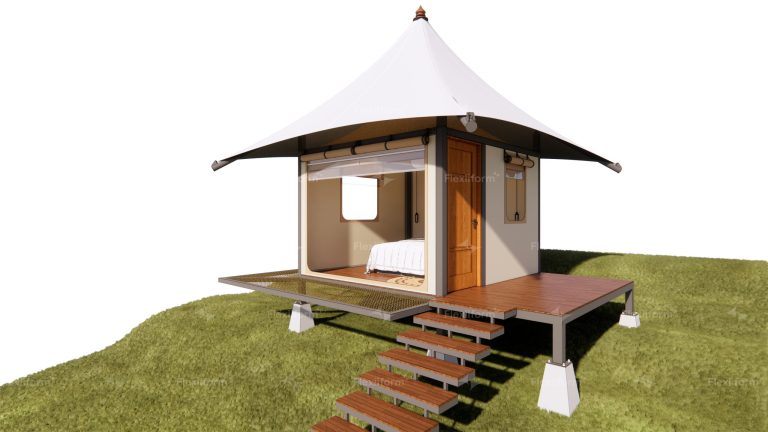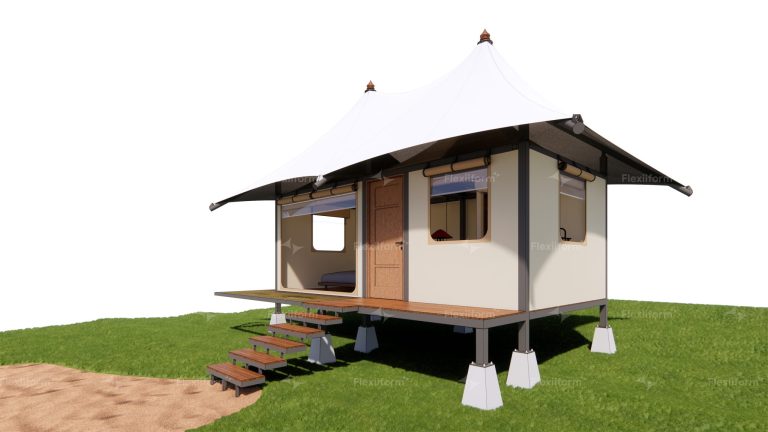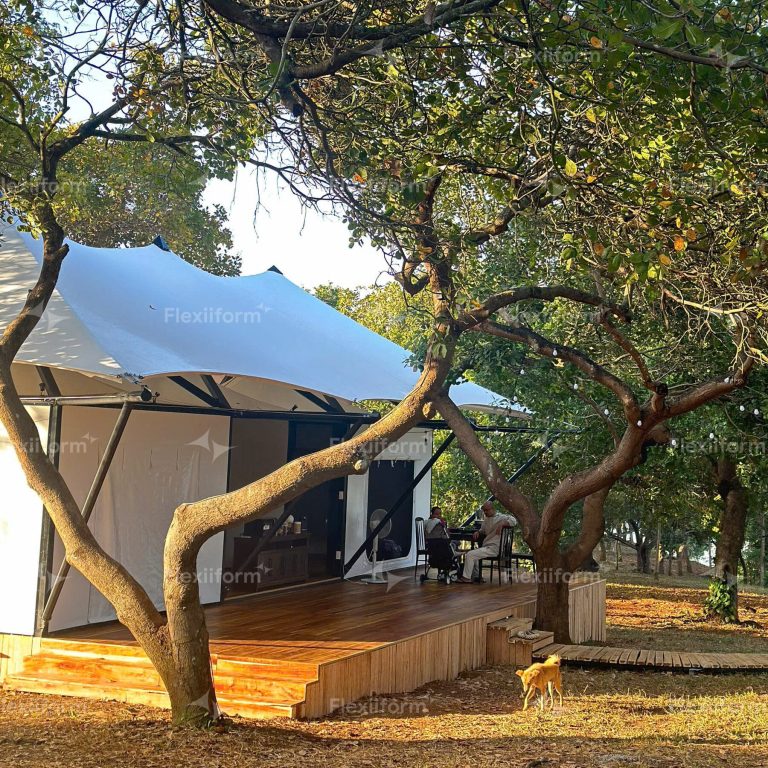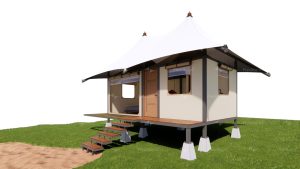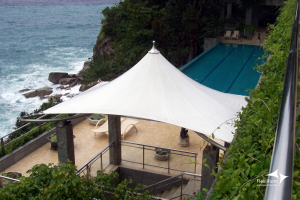
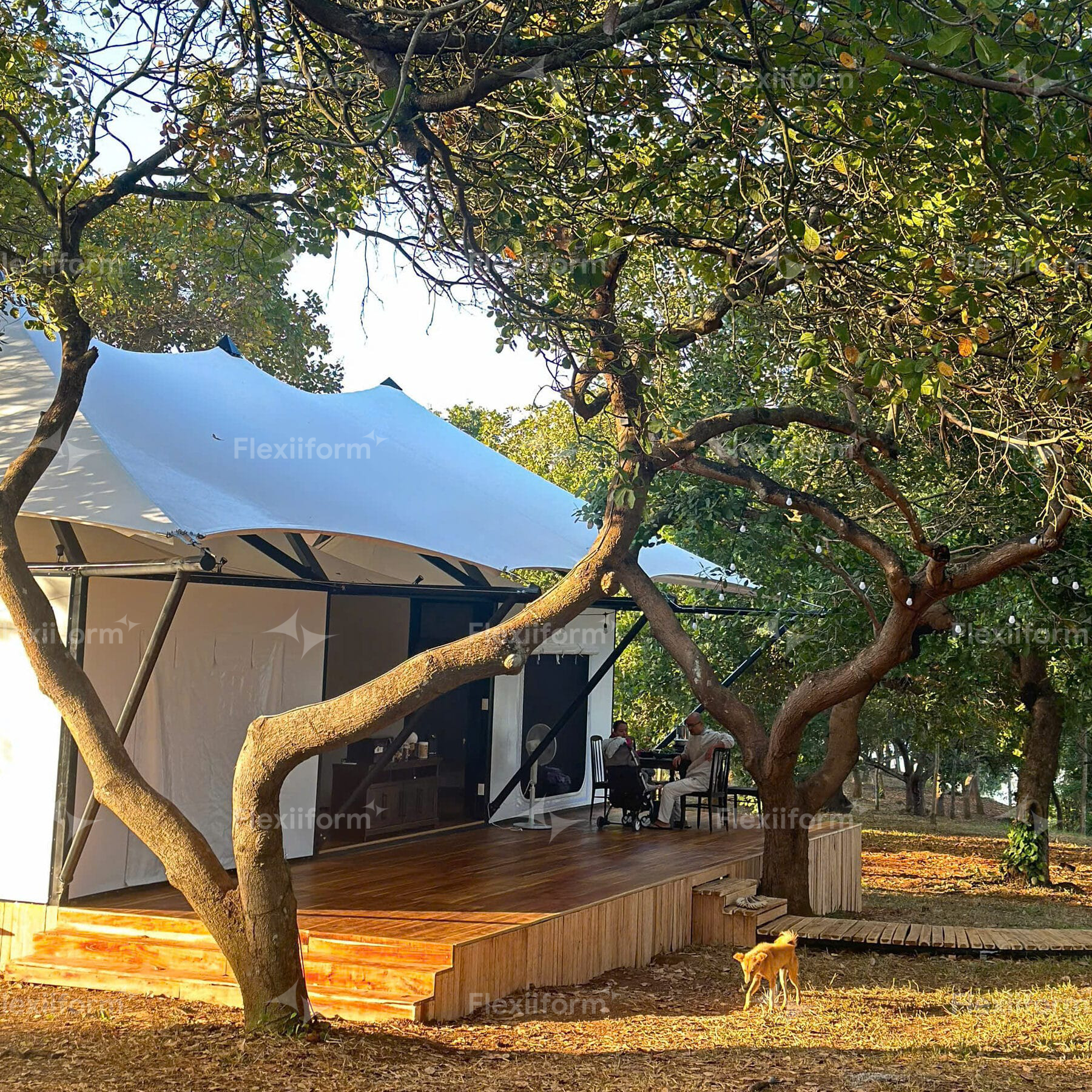
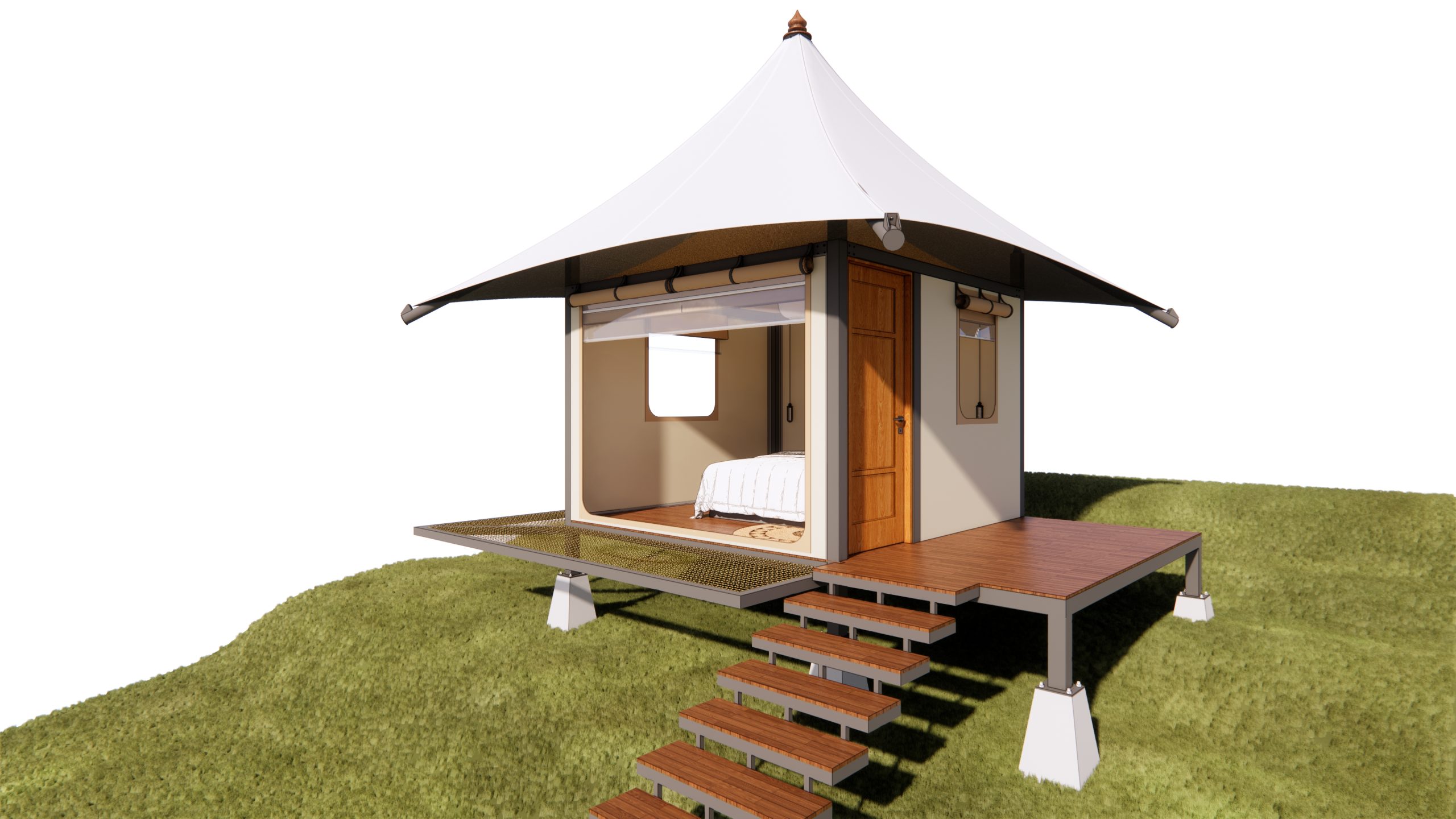
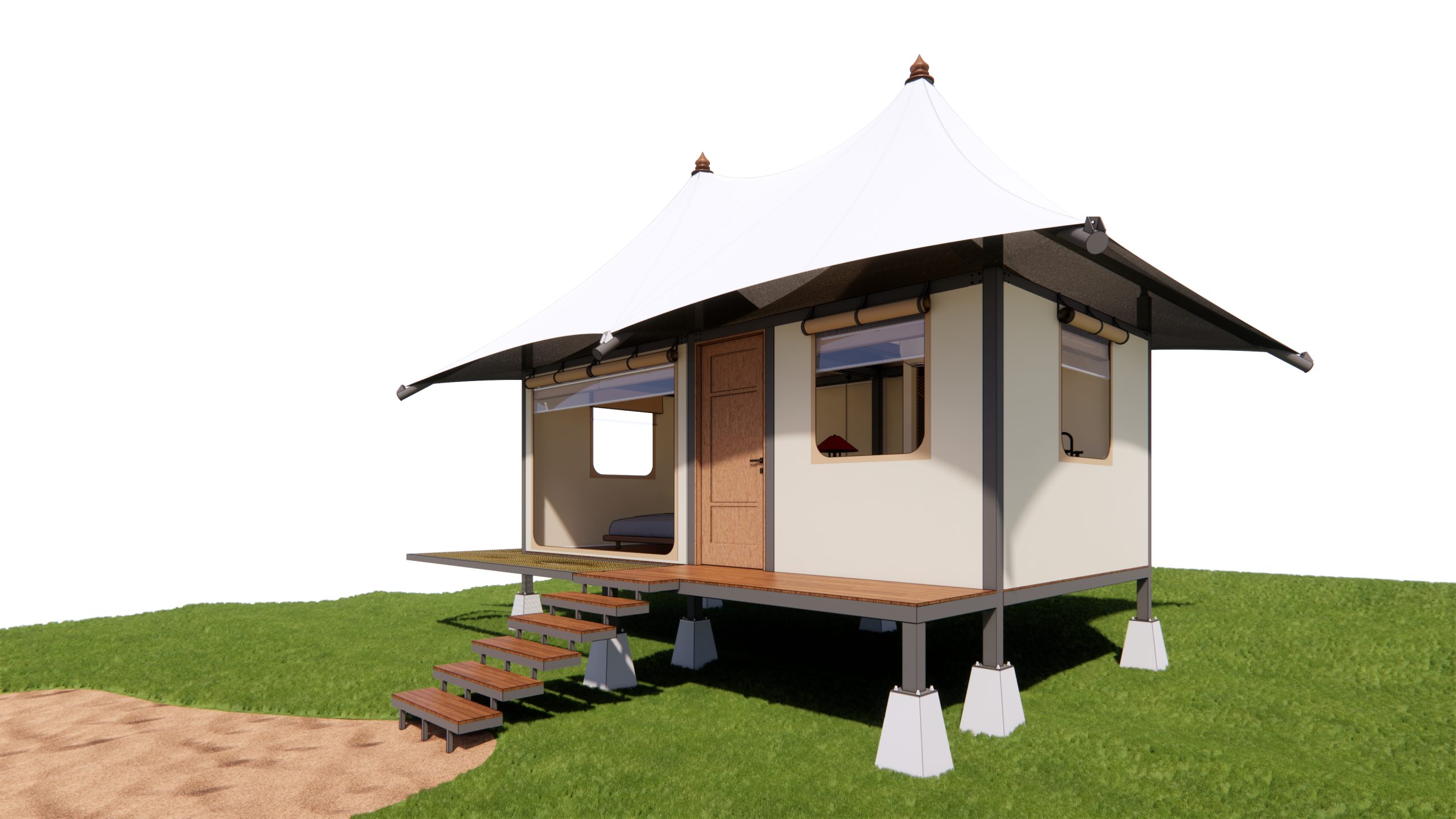
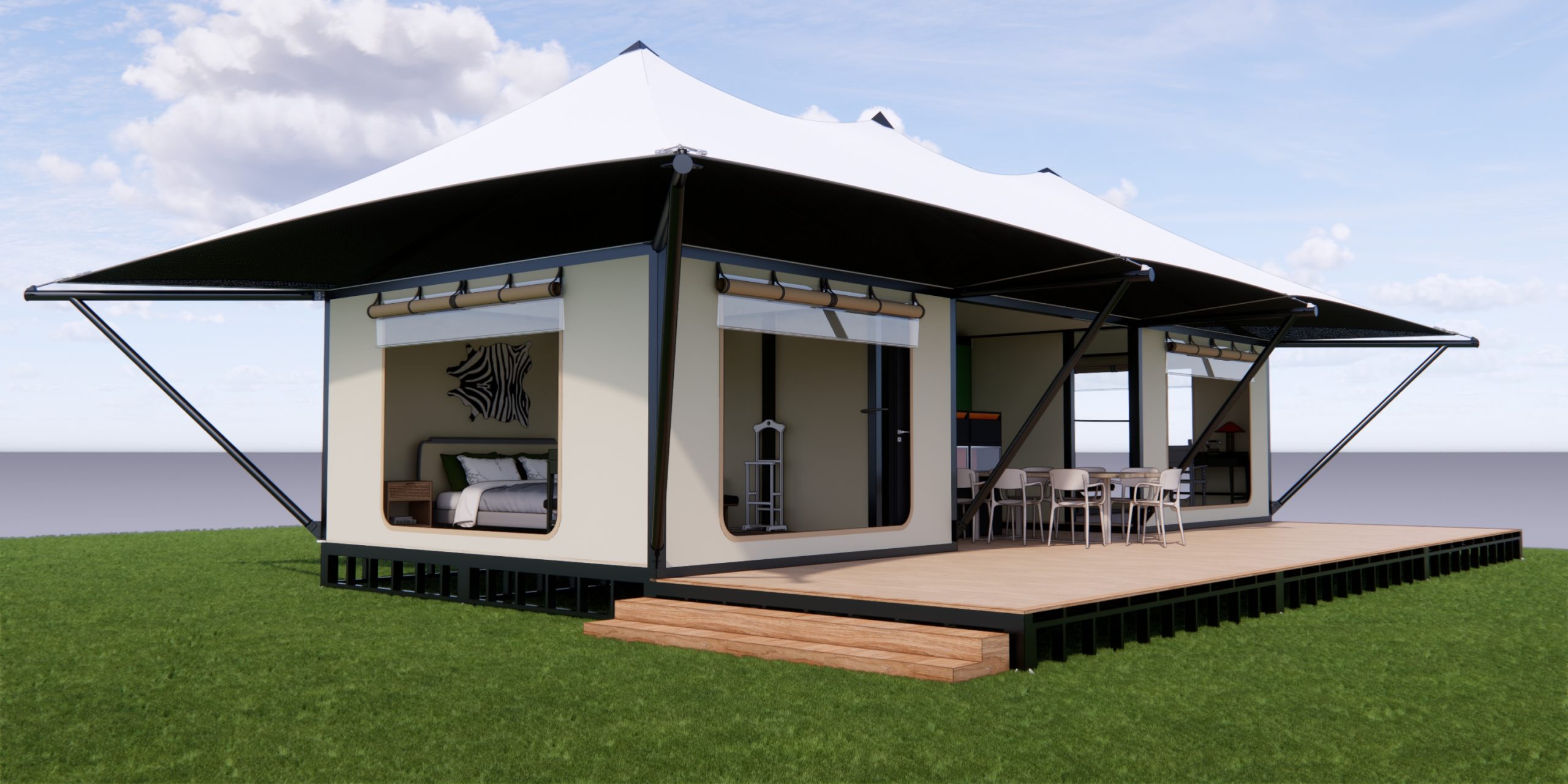
A cone glamping tent from Wild Duck Glamping Tent is a steel-frame room with walls and doors, roofed by a PVDF tension membrane pulled up into one, two or three cone-shaped peaks. The range has three models: the Single Cone Tent for 2 guests (3 x 4.5 m deck), the Double Cone Tent for families of 4 or more (4 x 7 m deck) and the Triple Cone Tent, a two-bedroom suite with a central bathroom (8 x 12 m deck). All three withstand 100 km/h winds, sit on a raised timber deck and go up without digging foundations.
Wild Duck’s cone tents are not canvas bell tents pitched around a centre pole. They are permanent resort rooms: a load-bearing steel frame, a tensioned roof that extends into shaded eaves, and enough space inside for a bed, air conditioning and a bathroom. This article explains how a cone glamping tent is built, compares the single, double and triple cone models, and suggests which one fits each type of project.
Cone glamping tent at a glance
- Structure steel-frame room, PVDF membrane roof tensioned to 1, 2 or 3 cone peaks, roof extending into eaves on all sides
- Three models Single Cone (2 guests), Double Cone (4+ guests), Triple Cone (4+ guests, 2 bedrooms, 1 bathroom)
- Standard deck 3 x 4.5 m, 4 x 7 m and 8 x 12 m
- Height 3.5 m ceiling on all three; 4.6 m peak (single and double), 5.1 m peak (triple)
- Roof opaque white PVDF, partially translucent
- Walls opaque white PVC, 100% blackout
- Wind resistance 100 km/h (0.5 kN/m²)
- Installation no foundation digging, no heavy machinery
- Lifespan 5 to 10 years (single and double), 10 to 15 years (triple)
How a cone glamping tent is built
All three cone models share one design: a box-shaped room with a steel frame, membrane walls and doors, under a tension membrane roof pulled up to the peaks. Each extra peak adds length, so more peaks mean a longer tent with more zones inside.
Steel frame and cone peaks
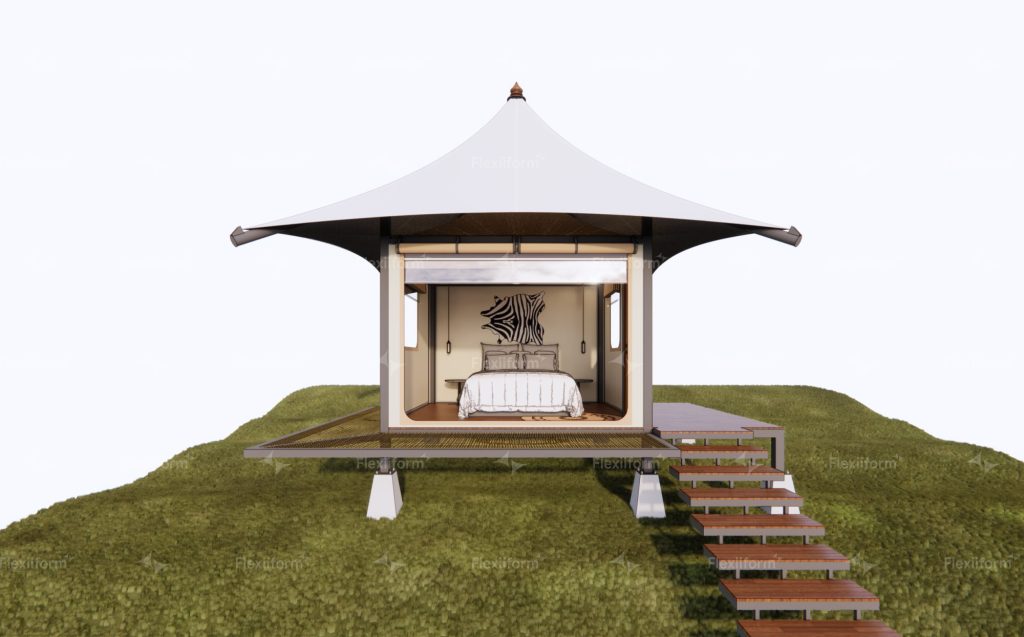
The steel frame forms the room and carries the peak masts. At each peak the membrane is pulled up high and then falls away on four sides, giving the pointed cone shape. The peaks rise 1.1 to 1.6 m above the ceiling line, so the room feels taller and airier than its floor area suggests.
PVDF roof and shaded eaves
The roof is opaque white PVDF that lets some daylight through, so the interior is bright without glare. The roof extends beyond the room frame and is tensioned down to the corners, forming eaves that shade the doors and walls from sun and rain. The roof slopes away from every peak, so rainwater runs off instead of pooling. Fully translucent and 50% translucent membranes are available.
Walls, doors and windows
Walls are opaque white PVC with 100% blackout for privacy in the sleeping area. The standard door is 1.5 x 2.2 m and windows are 0.6 x 1.1 m (3 windows on the single and double, 4 on the triple). Each opening has an insect mesh, a ventilation layer and a solid privacy layer for air-conditioned nights. The number, size and position of openings can all be changed to suit the project.
Raised timber deck
The tent sits on a timber deck raised off the ground on footings or a flat concrete pad, so no foundation digging is needed. The deck is usually larger than the room to leave a porch in front of the door. Deck, foundations, lifting equipment and shipping are not included in the tent package; the owner prepares them to suit the site.
Single Cone Tent: a room for couples
The Single Cone Tent has one central peak, a 3 x 4.5 m deck, a 3 x 3 m room, a 3.5 m ceiling and a 4.6 m peak. The square room is small but tall, with space for a double bed, bedside tables and a small seating corner; the rest of the deck becomes a front porch.
It is the most compact tent in the cone range, suited to couples’ rooms, honeymoon suites and steep or narrow plots where larger tents will not fit. Because each tent needs so little land, several single cone tents can be spread along a hillside or between trees while keeping guests apart.
Double Cone Tent: a family room with its own bathroom
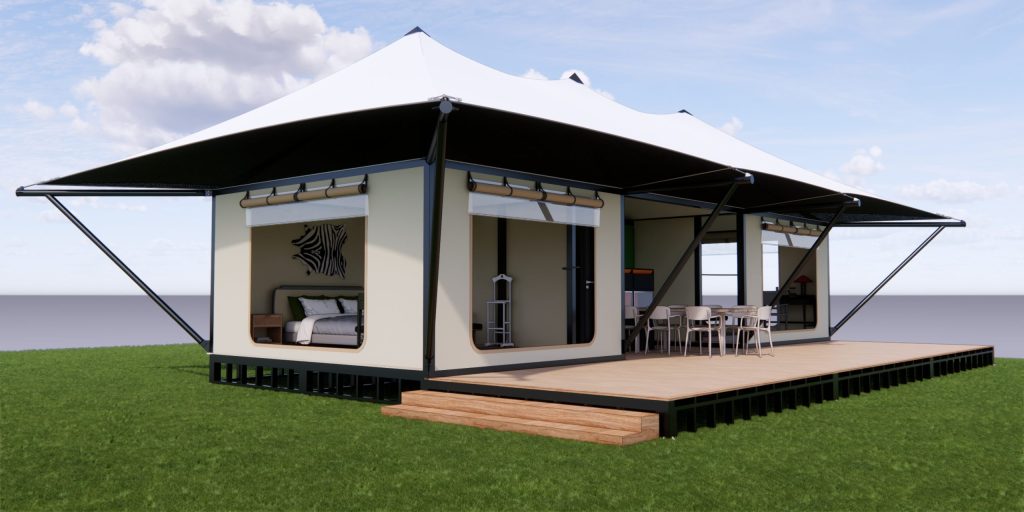
The Double Cone Tent has two symmetrical peaks along its length, a 4 x 7 m deck, a 3 x 6 m room, a 3.5 m ceiling and a 4.6 m peak. The room is twice as long as the single cone, so it splits into a sleeping area, a seating area and a private bathroom for families or groups of 4 or more.
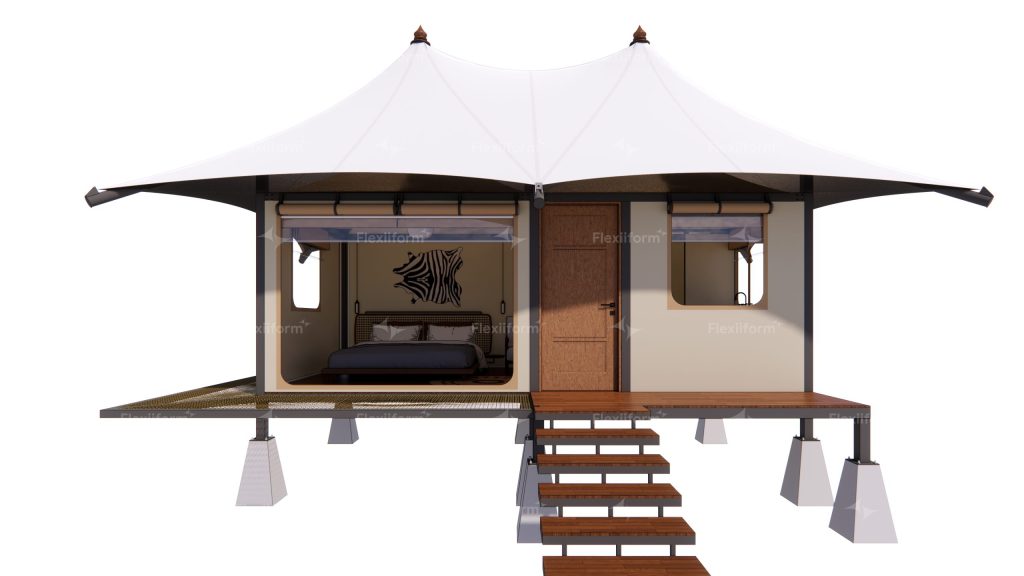
The two peaks create two tall air spaces above the room. Warm air rises into the peaks, keeping the living area below cooler. This is the most balanced model for floor area, guest count and cost, and is often the mid-range room type that makes up most of a resort.
Triple Cone Tent: a two-bedroom suite
The Triple Cone Tent is the largest model, with an 8 x 12 m deck, a 4.8 x 12 m room, a 3.5 m ceiling and a 5.1 m peak. Its three peaks sit in a row: a private bedroom at each end and a bathroom in the middle. It carries a 2,000 kg load and lasts 10 to 15 years, longer than the two smaller models.
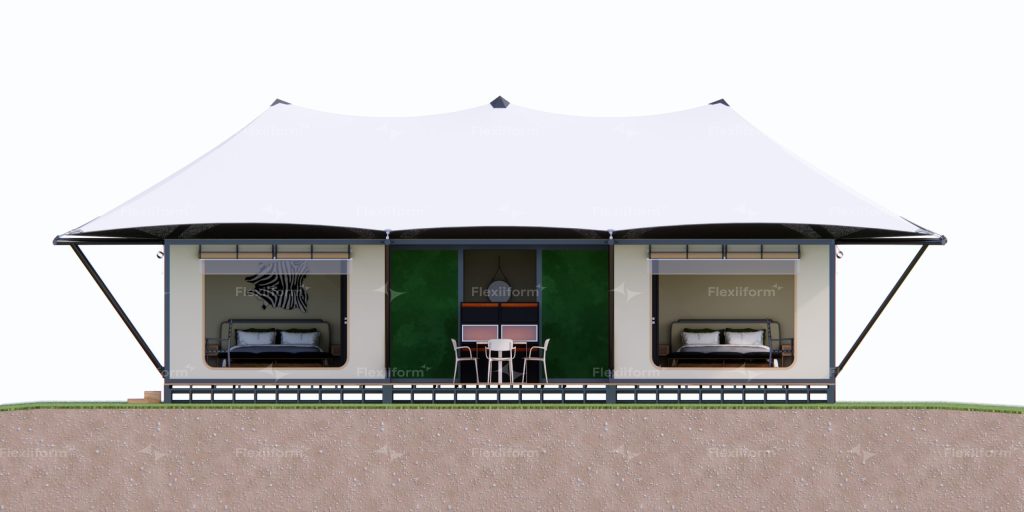
With two separate bedrooms and 96 m² of deck, the Triple Cone Tent works as a true suite for multi-generation families or groups of friends. Its three tall peaks are visible from a distance, so it usually takes the best spot on site and becomes the signature image of the resort.
Single vs double vs triple cone tent
| Feature | Single Cone | Double Cone | Triple Cone |
|---|---|---|---|
| Peaks | 1 | 2 | 3 |
| Deck size | 3 x 4.5 m | 4 x 7 m | 8 x 12 m |
| Room size | 3 x 3 m | 3 x 6 m | 4.8 x 12 m |
| Ceiling height | 3.5 m | 3.5 m | 3.5 m |
| Peak height | 4.6 m | 4.6 m | 5.1 m |
| Capacity | 2 guests | 4+ guests | 4+ guests, 2 bedrooms |
| Bathroom | Project-dependent | Room for a private bathroom | 1 central bathroom |
| Standard openings | 1 door, 3 windows | 1 door, 3 windows | 1 door, 4 windows |
| Permitted load | 1,500 kg | 1,500 kg | 2,000 kg |
| Lifespan | 5 to 10 years | 5 to 10 years | 10 to 15 years |
| Reference price (Nov 2026) | 219 million VND | 412 million VND | 1.2 billion VND |
| Best for | Couples, honeymoons, narrow sloping plots | Family rooms, mid-range room type | Premium suites, multi-generation families |
All three withstand 100 km/h winds (0.5 kN/m²) and use an opaque white PVDF roof with blackout PVC walls. Reference prices are for one standard tent as listed on the product pages, excluding deck, foundations and shipping; actual prices depend on size, membrane, openings and the number of tents.
Which cone tent should you choose?
- Small resort, mostly couples: choose the Single Cone. It has the lowest cost per room and fits into small corners where larger tents cannot go.
- Family guests who need an en-suite: choose the Double Cone, with space for a bed, seating, air conditioning and a private bathroom.
- A top room category or a landmark building: choose the Triple Cone, with two bedrooms and a shared bathroom like a small house.
- A resort with several room types: combine all three. They share the same peaked roof and materials, so the site looks consistent even though each tent is a different size.
Cone tent vs tipi tent vs arch tent
A steel-frame tipi tent is also cone-shaped, but it is a single tall cone (7 x 7 m deck, 5 m peak) with walls that slope with the roof. A cone tent has upright walls with the tensioned roof above, so the room edges stay full height and furniture fits against the walls. Cone tents can also be joined into 2 or 3 peaks to make longer, multi-room units, which a single tipi cannot do.
Compared with an arch glamping tent, a cone tent has pointed peaks and wider eaves for a tropical resort look; an arch tent has a smooth curved roof that suits a modern, minimal style.
What to prepare before installing a cone tent
- Site: enough room for the deck (from 3 x 4.5 m to 8 x 12 m) plus paths and spacing between tents, reasonably level or levelled with footings.
- Deck and footings: a raised timber deck on footings or a flat concrete pad, built by the owner to suit the site.
- Vehicle access: a route for trucks carrying the frame and membrane; scaffolding, trolleys or a crane may be needed to raise the peaks.
- Power and water: the Double and Triple Cone usually include a bathroom, so plan water supply, drainage and power for air conditioning in advance.
Send Wild Duck your site plan and target room count for advice on models, layout across the site and a quotation.
Cone glamping tent FAQ
What is a cone glamping tent?
A cone glamping tent is Wild Duck Glamping Tent’s Cone range: a steel-frame room with walls and doors under a PVDF tension membrane roof pulled up into 1, 2 or 3 cone peaks. It is used as a permanent guest room for resorts and glamping sites.
Is a cone tent the same as a canvas bell tent?
No. A bell tent is a canvas tent pitched around a centre pole for camping. Wild Duck’s cone tents have a load-bearing steel frame, upright walls, doors and windows, sit on a raised timber deck and can include a private bathroom.
What is the difference between the single, double and triple cone tent?
Size and number of rooms. The Single Cone has a 3 x 4.5 m deck for 2 guests; the Double Cone has a 4 x 7 m deck for families of 4 with space for a private bathroom; the Triple Cone has an 8 x 12 m deck with 2 bedrooms and a central bathroom.
How much wind can a cone tent withstand?
All three models withstand 100 km/h winds (0.5 kN/m²). The permitted load is 1,500 kg for the single and double cone and 2,000 kg for the triple cone.
Does a cone tent get hot inside?
The PVDF roof limits heat absorption and the peaks create tall air spaces where warm air collects, so the living area below stays airier. Openings have a mesh layer for daytime ventilation and a solid layer to hold the cool when the air conditioning is on.
Does a cone tent need foundations?
No digging is needed. The tent sits on a raised timber deck on footings or on a flat concrete pad, with no heavy machinery.
How long does a cone tent last?
The Single and Double Cone last 5 to 10 years and the Triple Cone 10 to 15 years. The membrane is easy to clean and maintenance costs are low.
How much does a cone glamping tent cost?
Reference prices for one standard tent (Nov 2026): Single Cone 219 million VND, Double Cone 412 million VND, Triple Cone 1.2 billion VND, excluding deck, foundations and shipping. Send your project details via the Contact page or the quote button on each product page, and Wild Duck will reply within 24 working hours.
Choosing cone tents for your resort?
Send your site plan and target room count. Wild Duck will suggest a mix of single, double and triple cone tents, a site layout and a quotation within 24 working hours.
Get advice on cone tents