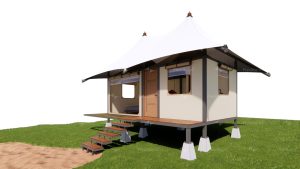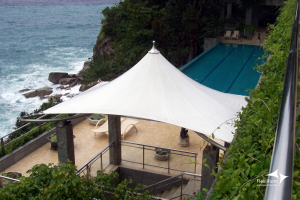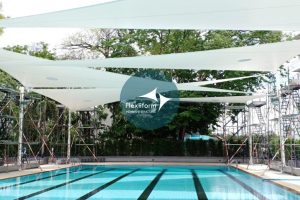
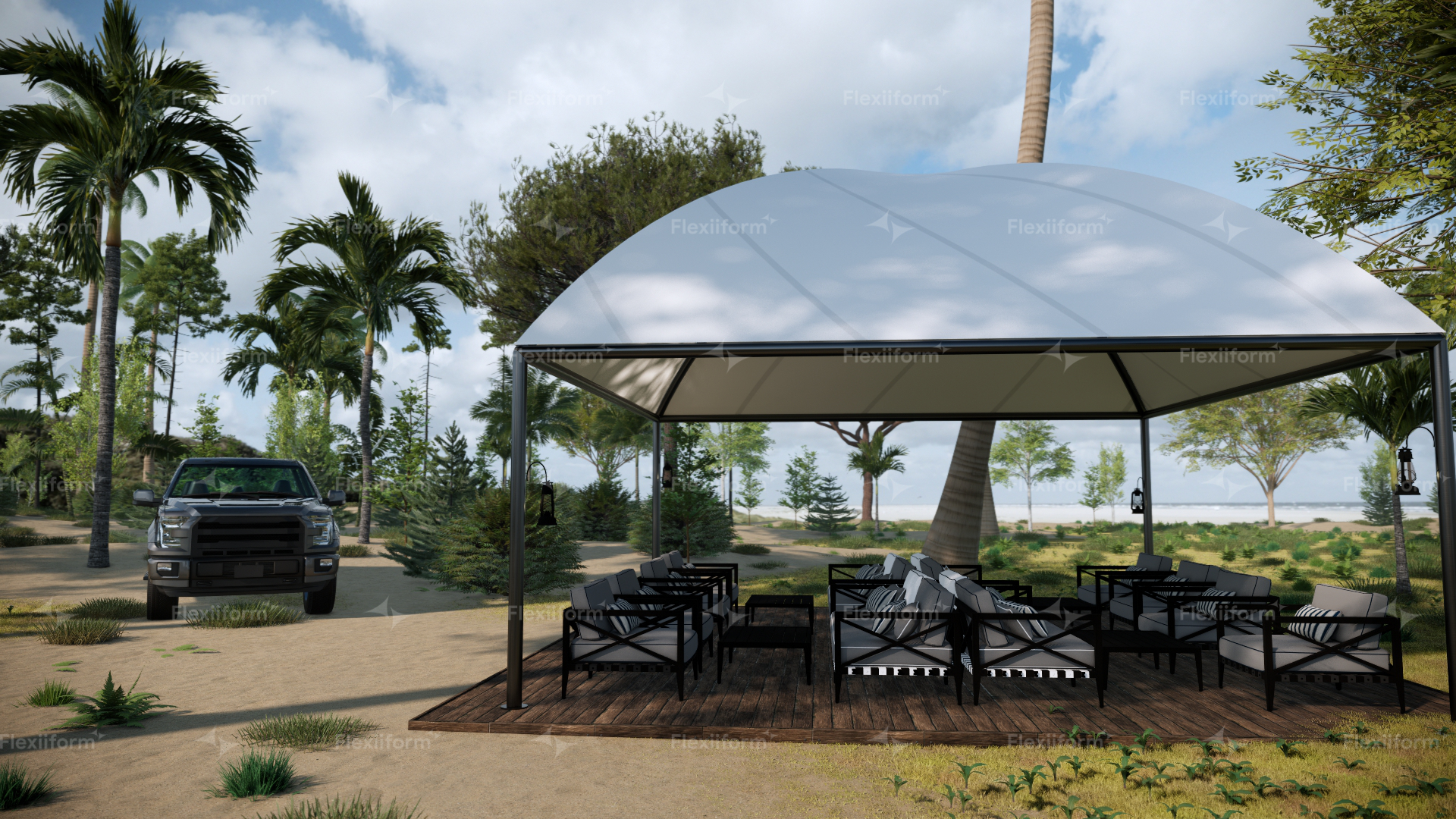
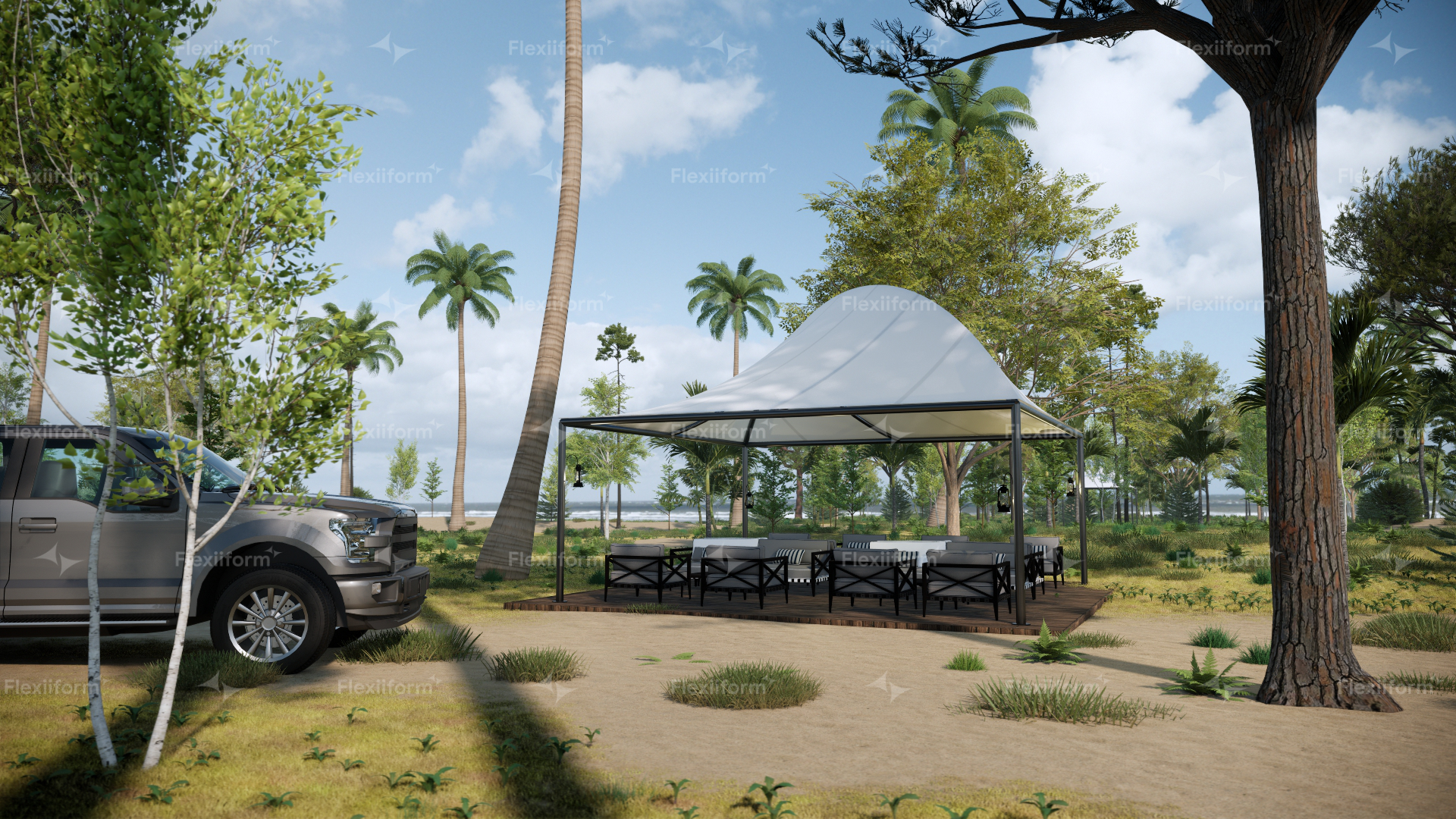
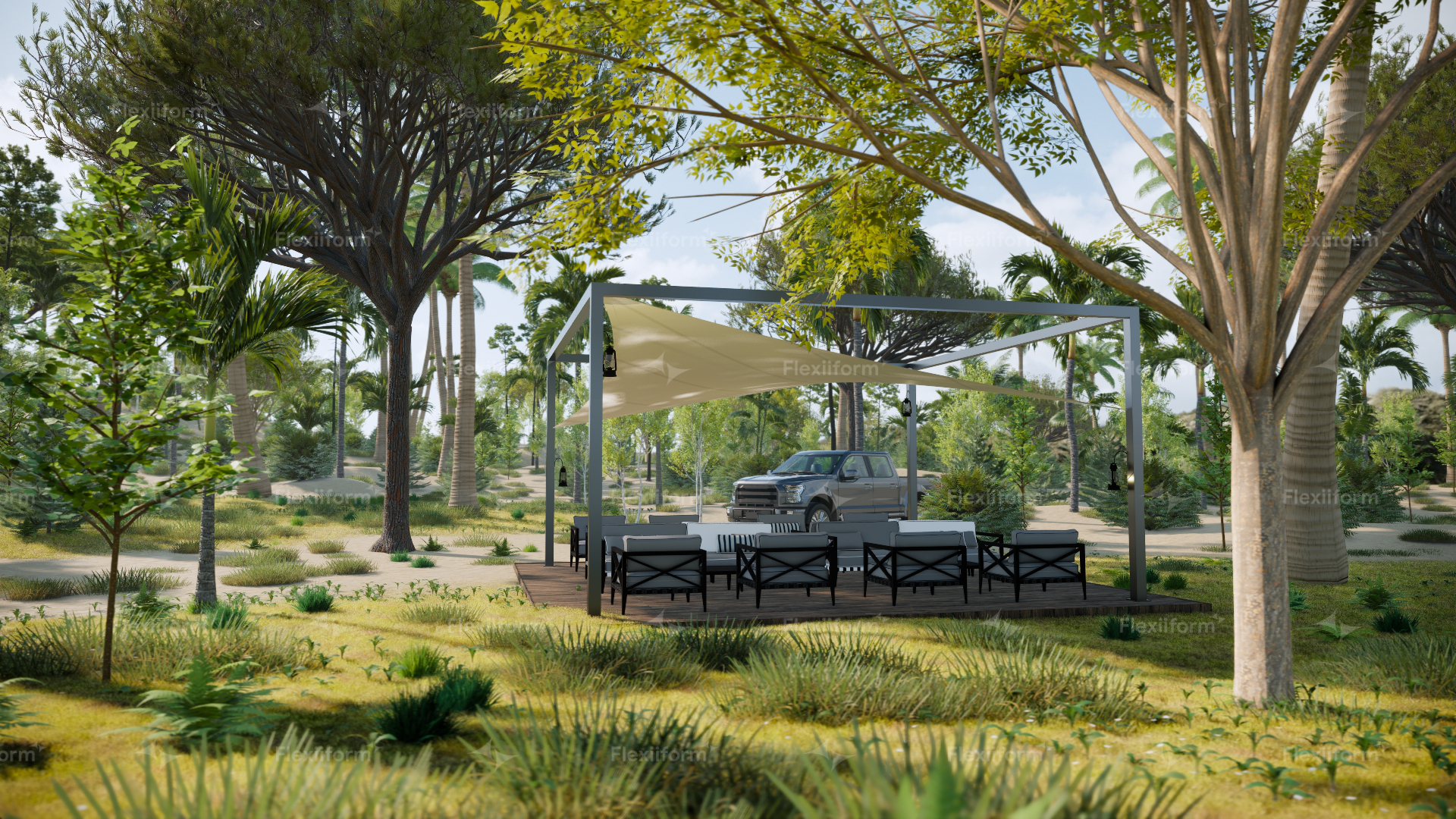
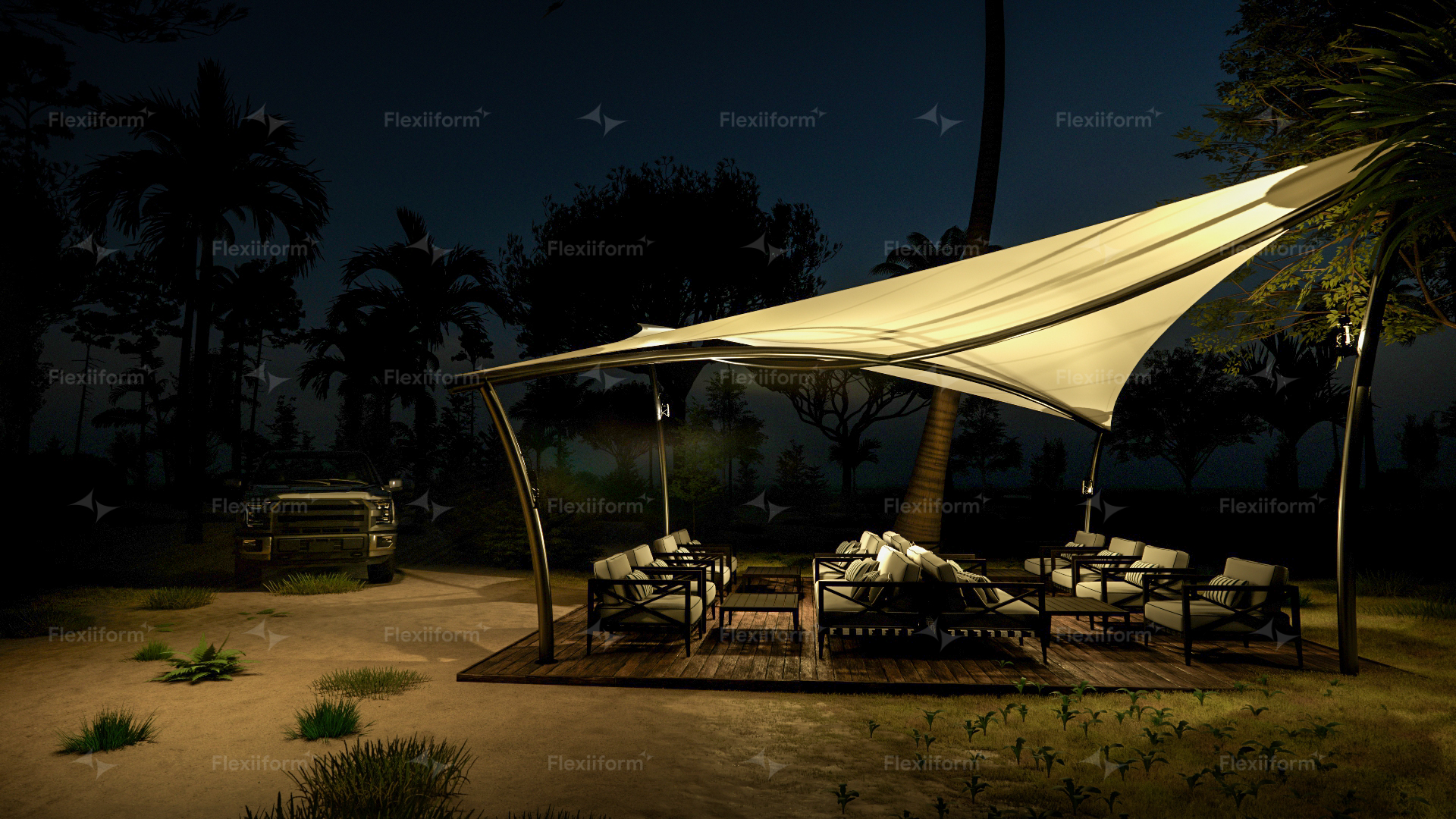
A garden canopy is a roof that shades and shelters an outdoor area of a home garden, villa, homestay or resort from sun and rain: an outdoor dining table, a tea corner, a barbecue spot, a walkway or the seating beside a pool. The common options are patio umbrellas, tarps or shade cloth, timber trellis pergolas for climbing plants, metal roofs, polycarbonate roofs, glass roofs, retractable awnings and tensile fabric (membrane) roofs. Which one fits depends on whether the area must stay usable in the rain, whether the roof can be fixed to the house or has to stand on its own in the garden, and whether you want it to blend into the landscape or become a feature.
This guide compares eight types of garden shade structure, explains when a retractable cover makes sense and when a fixed one does, sets prefabricated tensile pergolas against custom-designed fabric roofs, then suggests a model for each kind of garden and what to check before you build.
Garden canopies at a glance
- Used for outdoor dining, tea corners, barbecue areas, lounge corners, walkways, pool-side seating and roof terraces at homes, villas, homestays and resorts
- Eight common types patio umbrellas, tarps or shade cloth, timber trellis pergolas, metal roofs, polycarbonate roofs, glass roofs, retractable awnings, tensile fabric (membrane) roofs
- Rainproof metal, polycarbonate and glass roofs, retractable awnings (when extended), properly pitched tarps and closed-roof tensile pergolas. Umbrellas only handle light rain; shade cloth, plant-covered trellises and shade sails are mainly for sun
- Attached or freestanding awnings, metal and glass roofs are usually fixed to the house wall; pergolas and tensile roofs can stand on their own in the middle of the garden
- Two routes to a fabric roof a tensile membrane pergola chosen from set models on a prefabricated frame (Wild Duck), or a fabric roof custom-designed for the shape of the site (the company Flexiiform)
- What Wild Duck supplies 7 prefabricated tensile membrane pergolas, curtain and partition modules, fabric door canopies and a star shade tent; not umbrellas, retractable awnings or glass roofs
Which parts of a garden need a canopy?
- Outdoor dining: a family table or a party table in the garden needs a closed roof so dinner does not have to move indoors when it rains.
- Tea or reading corner: a small seating spot, usually where the garden has its best view, so the roof should be compact and keep the view open.
- Barbecue area: the person at the grill needs rain cover, but the grill itself must sit where smoke can escape (see the checklist below).
- Back and front yard: the strip next to the house is often covered by a roof fixed to the wall; seating further out needs a freestanding structure.
- Beside the pool: loungers and seats for resting after a swim. Our guide to pool pergolas for resorts covers this area in detail.
- Shared areas at homestays and resorts: where guests gather, have breakfast, wait for transport or hold small weekend parties.
Eight garden shade structures compared
The table compares common garden canopy types by rain protection, strengths and what to watch for over the long term:
| Canopy type | Keeps rain off | Strengths | Watch for |
|---|---|---|---|
| Patio umbrellas | Light rain, without wind | Cheap, easy to move, put away when not in use | Must be closed in strong wind; covers one table; rain falls through the gaps between umbrellas |
| Tarps or shade cloth | Tarps yes, shade cloth no | Low cost, quick to put up | A tarp without enough pitch collects water and sags; shade cloth only reduces sun; looks temporary if left up |
| Timber trellis for climbing plants | No | Close to nature, natural shade once plants cover it | You wait for plants to grow; natural timber needs treatment against rot and termites; leaves and flowers drop on the seats |
| Metal roof | Yes | Fully closed, easy to build, moderate cost | Hot and noisy in rain without insulation; can look like a carport in the middle of a garden |
| Polycarbonate roof | Yes | Lets light through, lighter than glass | Can trap heat under strong sun; shows dust, leaves and moss; may yellow over time |
| Glass roof | Yes | Bright and elegant, keeps the view of the sky | Heavy, so it needs a strong frame; hot without a solar coating; needs frequent cleaning; must use safety glass |
| Retractable awning | Yes, when extended | Folds away when you want open sky, motorised versions available | Usually fixed to a wall, so it only covers the strip next to the house; must be retracted in strong wind; mechanical parts need servicing |
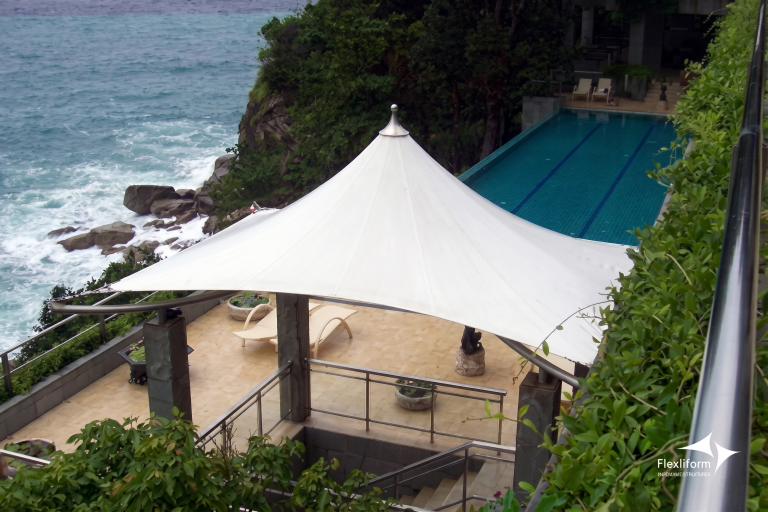
| Tensile fabric (membrane) roof | Yes (closed roof); shade sails are mainly for sun | Stands free in the garden; peak, dome, wave and sail shapes become a feature; light roof, curtains and partitions can be added | Usually costs more up front than umbrellas or temporary tarps; must be tensioned correctly; clean the membrane regularly to keep it bright |
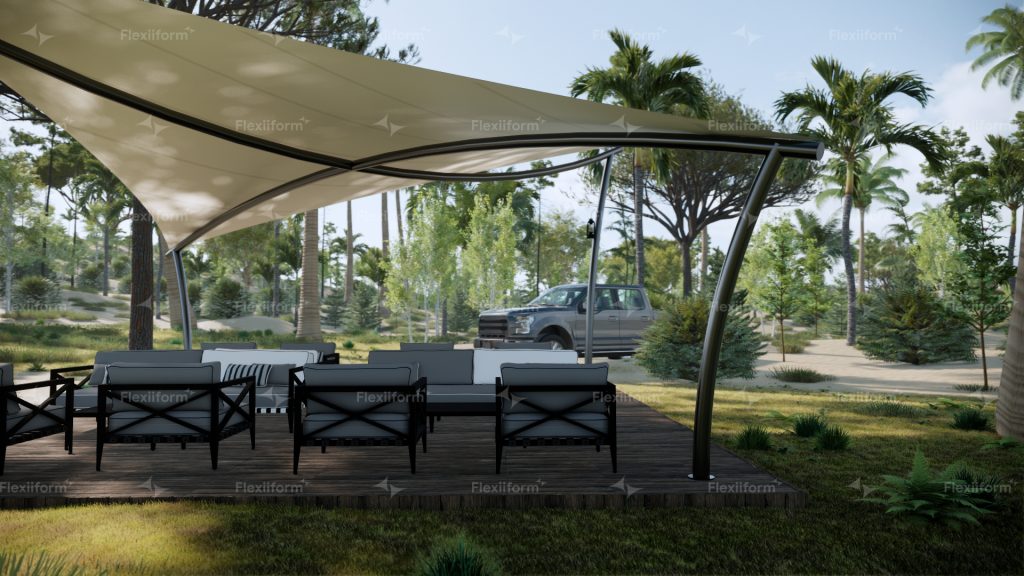
Many gardens combine two types: a roof fixed to the house over the strip next to it, and a freestanding canopy for seating in the middle of the garden. A planted trellis is still a lovely choice for a walkway, as long as nobody needs to sit there in the rain.
Retractable or fixed: which garden canopy?
Retractable garden canopies are usually folding awnings, roofs that slide on rails or roller blinds, opened by hand or by motor. Their strength is that they fold away: retract the roof in the evening to see the sky, close it when the wind picks up. In exchange, most are fixed to the house wall, so they only cover the strip of garden next to it, and the rails and motors need servicing.
Fixed structures such as pergolas, metal roofs or tensile roofs can cover seating in the middle of the garden, far from any wall, and nobody has to open or close them when the weather changes. With a tensile pergola, the flexible part is the curtain: let it down on an open side when rain blows in or the afternoon sun is low, tie it back when you want air.
Wild Duck Glamping Tent does not make umbrellas, retractable awnings or glass roofs. Patio umbrellas are supplied by the company Flexiiform. For folding awnings, sliding roofs on rails and roller blinds, Flexiiform has its FlexiiSmart retractable range: aluminium frames and rails, a fabric roof that extends and retracts, with optional sun and wind sensors, LED lighting and remote control.
If you need cover for a holiday season or one large party and then want it gone, Wild Duck’s Star Shade Tent is the simpler option: a single-mast tent with a multi-armed tensioned fabric roof, no excavated foundations, and it can be taken down and moved elsewhere.
Tensile garden canopies: prefabricated or custom-designed?
A tensile fabric roof (also called a membrane roof) is a technical fabric pulled tight over a frame or between masts, forming a light curved roof without purlins or roof sheets. There are two ways to get one for a garden:
| Prefabricated tensile pergola | Custom-designed tensile roof | |
|---|---|---|
| Shape | Chosen from set models: peak, dome, wave, sail | Designed around each site: sails on masts, single or double arch, single mast with arms, hexagon, free form |
| Structure | Frame and roof made in the workshop on a modular system, then assembled on site | Masts, cables and fabric engineered for each project |
| Changes later | Add curtains or partitions; swap the roof for a different shape on the same frame | Replace the fabric when it ages; a new shape usually means a new structure |
| Suits | One or a few seating areas of familiar size, where you want to pick a model and install quickly | Unusually shaped or very large sites, or a one-of-a-kind canopy |
| Who makes it | Wild Duck Glamping Tent (Pergola Modules) | The company Flexiiform |
If your garden needs a fabric roof designed from scratch, Flexiiform designs and builds custom tensile structures in Vietnam, including sails on masts, single and double arches, single-mast and twin-mast canopies and hexagonal roofs. The rest of this guide covers Wild Duck’s prefabricated pergolas.
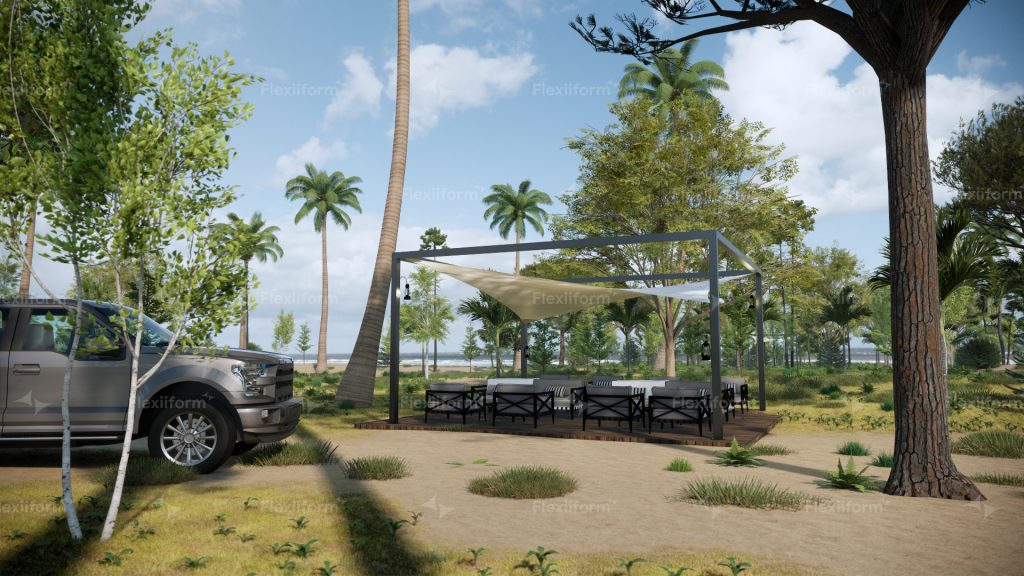
Choosing a garden canopy for each kind of garden
Wild Duck offers 7 models in the Pergola Modules range, all on a prefabricated frame, with placement and post anchoring planned around the ground (timber deck, paving or garden soil). The table suggests a model for each kind of garden, based on each model’s roof shape and coverage:
| Garden or seating area | Suggested model | Why |
|---|---|---|
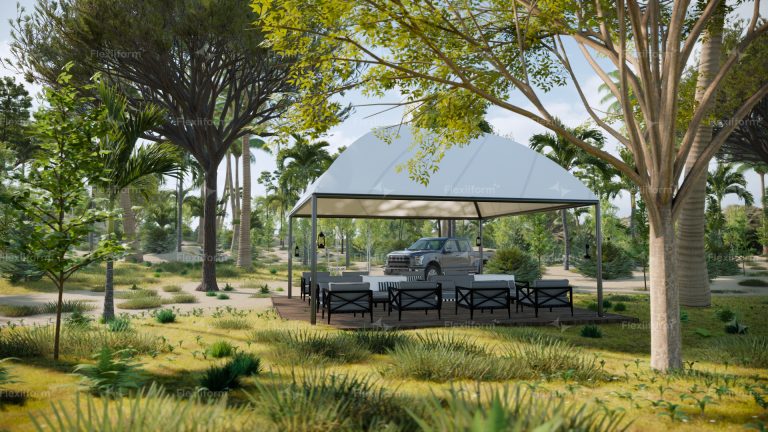
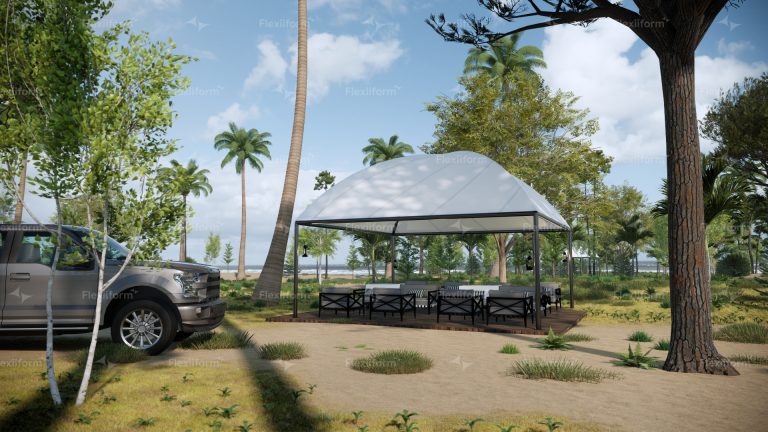
| Outdoor dining in the middle of a lawn or garden | Dome Roof Pergola | A closed dome roof keeps sun and rain off the whole floor; balanced from every side, so it has no “back” in the middle of a garden |
| Gardens facing a lake or hills, roof terraces | Low Dome Pergola | A low, compact roof that keeps the view of the landscape open |
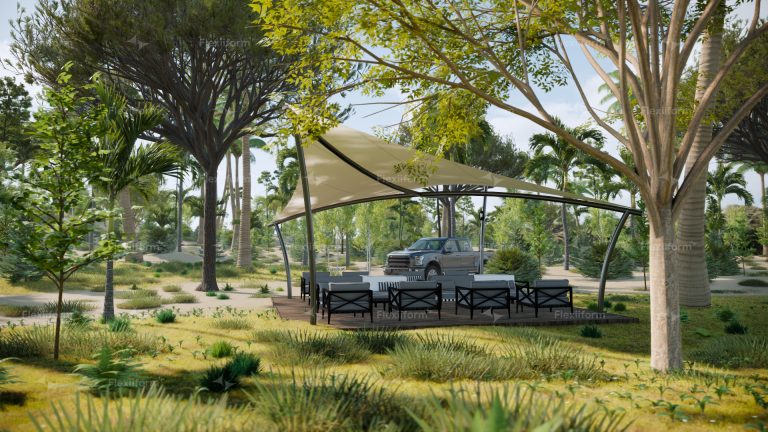
| Lush, tree-filled tropical gardens | Curved Post Sail Pergola | Curved posts and a twisted sail blend into the trees; mainly for sun, not rainproof |
| Tea corner, resting spot at the end of a path | Cone Roof Pergola | A familiar gazebo shape whose tall peak stands out among the trees; the steep roof sheds rain quickly |
| Outdoor sofa or lounge area | Flared Peak Pergola | The four corners flare out past the posts, so the shade is wider than the frame and covers seats near the edge |
| Pool side, architectural feature of the garden | Wave Roof Pergola | A continuous curved roof like a wave, keeping sun and rain off the whole seating area |
| Breezy daytime seating, coastal gardens | Shade Sail Pergola | A diagonal sail gives shade while letting the breeze through and keeping the sky in view; mainly for sun, not rainproof |
| Weekend parties, holiday season, events in the garden | Star Shade Tent | A single mast, open on all sides; no excavated foundations, can be moved when the season changes |
| Doors and windows that open onto the garden | Canopy Module | A tensioned fabric awning made to the measurements of each opening; can be attached to a pergola frame to extend the covered area |
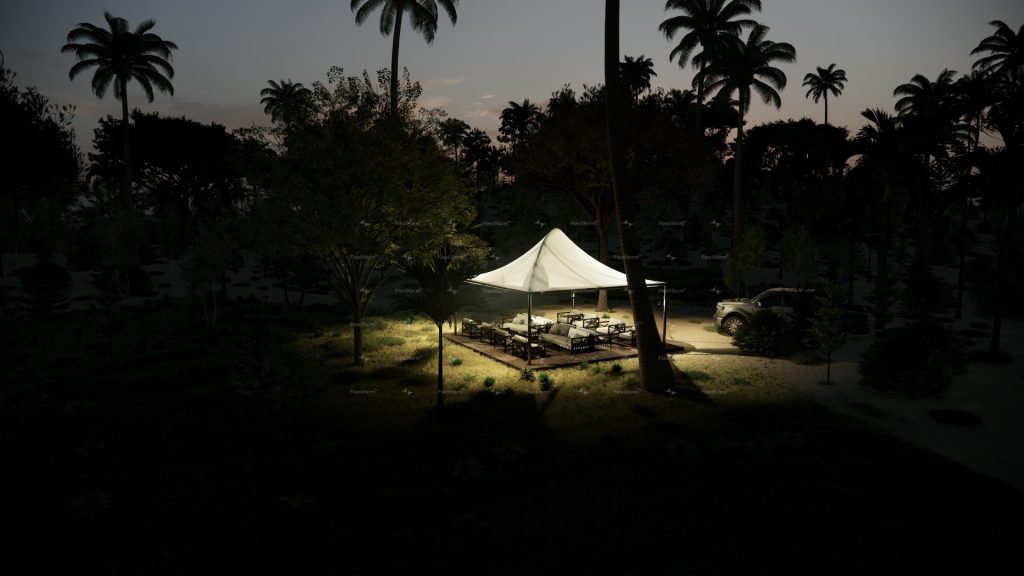
Where you need to sit through the rain, choose a closed roof: dome, peak or wave. These models take a Curtain Module to block low afternoon sun and wind-driven rain on the windward side, and a Partition Module to divide the seating into private areas. The two sail models suit morning and late-afternoon seating, where shade and air matter more than a closed roof. When a roof ages or you want a new look, the Tensile Roof Module replaces the roof while keeping the frame.
Garden canopies for homestays and resorts
At homestays and resorts the garden is where guests have breakfast, wait, gather in the evening and take photos. A few things to plan for shared areas:
- One roof language: canopies with the same shape or membrane colour make the grounds look coherent, unlike a garden mixing umbrellas, tarps and metal roofs.
- Standalone gazebos: resting spots along paths or by a pond are a separate choice; see our guide to resort gazebo design.
- Drinks counters: if the homestay runs a cafe or bar in the garden, our guide to the outdoor cafe canopy suggests a model for each zone.
- Membrane colour: product pages have a Choose a canvas color preview with ivory white, cream and smoke grey. Frame and membrane colours are specified to match the style of the property.
What to check before building a garden canopy
- Sun direction: find out which area gets the afternoon sun at the hours you sit outside most, so the roof and curtains face the right way.
- Where the rain goes: tensile and pitched roofs shed water quickly over their edges. Plan a drain or gravel strip where it lands, and do not let runoff flow onto a neighbour’s property.
- Ground for the posts: lawn, soil, timber deck, paving and concrete each need a different anchoring method. Check for water pipes, buried cables and irrigation lines before drilling or digging.
- Large trees nearby: dead branches can fall onto the roof in a storm, and leaves, flowers and sap dirty the membrane. Prune branches above the roof and avoid placing it directly under a big canopy of trees.
- Barbecue: put the grill where smoke can escape and away from the roof surface, or ask for a specific solution if you want to grill under the canopy.
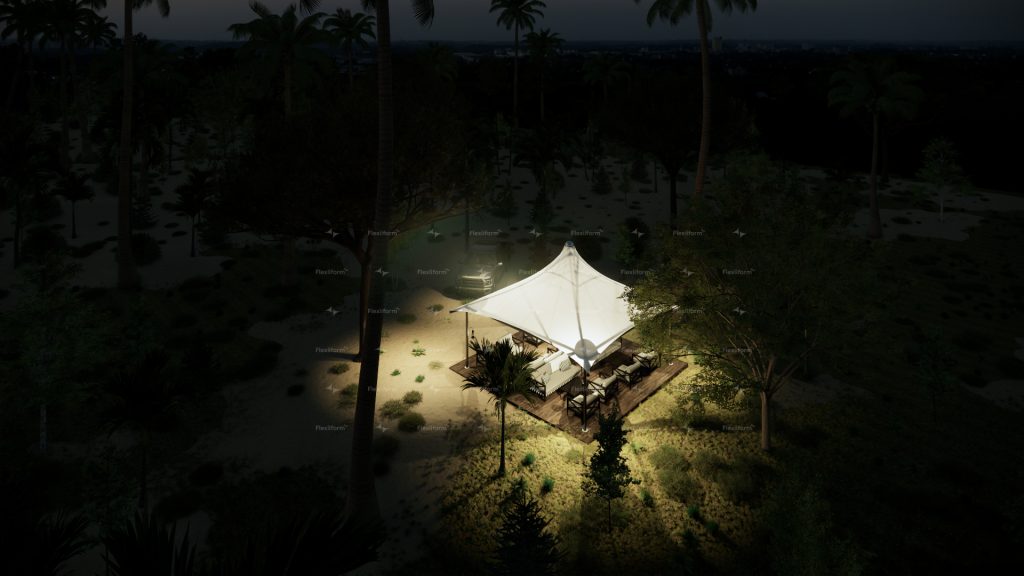
- Power, lights and fans: plan wiring for outdoor-rated lights and fans from the start. A light-coloured membrane reflects lighting well, so a lit seating area looks warm and is easy to spot after dark.
- Wind and storms: coastal, hillside and rooftop gardens usually see stronger wind than sheltered town gardens. Ask clearly about wind resistance and how curtains are handled in a storm.
- Local rules: a canopy close to the boundary, on a roof terrace or in a development with its own design rules may need approval from the building management or local authority first.
How much does a garden canopy cost?
Prices vary widely between umbrellas, temporary tarps, timber trellises, metal roofs, glass roofs, retractable awnings and tensile fabric roofs. For a Wild Duck tensile membrane pergola, the price depends on:
- The number of canopies and the total area to cover
- The model, size and height of each canopy
- Membrane material, membrane colour and frame colour
- How the posts are anchored to the ground
- Add-on modules such as curtains, partitions and door canopies
- The project location, transport and installation conditions
For a quote, send photos of the garden with dimensions (or a site plan), which areas need cover, which must stay dry in the rain and the roof shape you like through the Contact page, or use the quote button on any product page. Wild Duck replies within 24 business hours.
For more on pergolas and the difference between a trellis pergola and a roofed one, read What Is a Pergola?
Frequently asked questions about garden canopies
What is the best garden canopy?
There is no single best type for every garden. The strip next to the house suits a roof fixed to the wall, such as an insulated metal roof, a glass roof or a retractable awning. Seating in the middle of the garden that must stay usable in the rain is better served by a freestanding structure such as a tensile membrane pergola. Walkways and spots used only in the morning can use a planted trellis or a shade sail.
Is a tensile fabric garden canopy waterproof?
Closed-roof models such as the dome, peak and wave roofs keep both sun and rain off the seating below. Sail models mainly provide shade and are not rainproof. To block wind-driven rain on an open side, add a Curtain Module.
Does Wild Duck make retractable, motorised or glass garden roofs?
Wild Duck does not make umbrellas, retractable awnings or glass roofs; it supplies prefabricated tensile membrane pergolas, fabric door canopies, the Star Shade Tent and curtain and partition modules. Folding awnings, sliding roofs and roller blinds are in the FlexiiSmart range from the company Flexiiform, which also supplies patio umbrellas (flexiiform.vn).
Can a fabric canopy be designed for the shape of my garden?
Wild Duck’s pergolas have set roof shapes, while size, frame colour and membrane colour are specified around your site plan. For a fabric roof designed entirely around the shape of the site, such as sails on masts or a double arch, the company Flexiiform designs and builds that kind of structure.
Is it hot under a fabric garden canopy?
A tensile pergola is open on all four sides, so air moves through the seating area, unlike a low metal or polycarbonate roof that can trap heat underneath. Sail models also leave the roof partly open, so hot air escapes upwards. If the seating gets low afternoon sun, add a curtain on that side.
Do I need a permit for a garden canopy?
It depends on the location and local regulations. A canopy close to the boundary, on a roof terrace or in a development with its own design code usually needs more checking than a freestanding canopy in the middle of a garden. Ask the local authority or building management before you build.
How much does a tensile garden canopy cost?
The price depends on the number of canopies, the area covered, the model, the membrane material and any add-on modules. Send photos of the garden with dimensions through the Contact page and Wild Duck will quote within 24 business hours.
Planning a canopy for your garden?
Send photos of your garden with dimensions, the areas to cover and which must stay dry in the rain. Wild Duck will suggest models and a layout, and quote within 24 working hours.
Get garden canopy advice