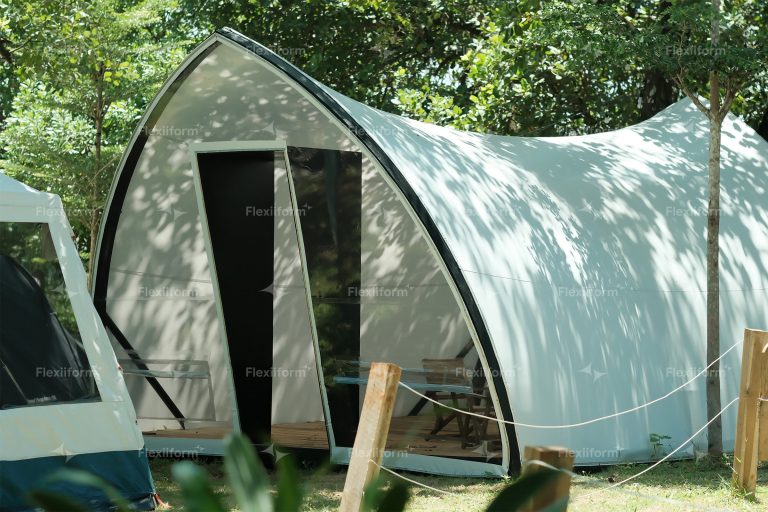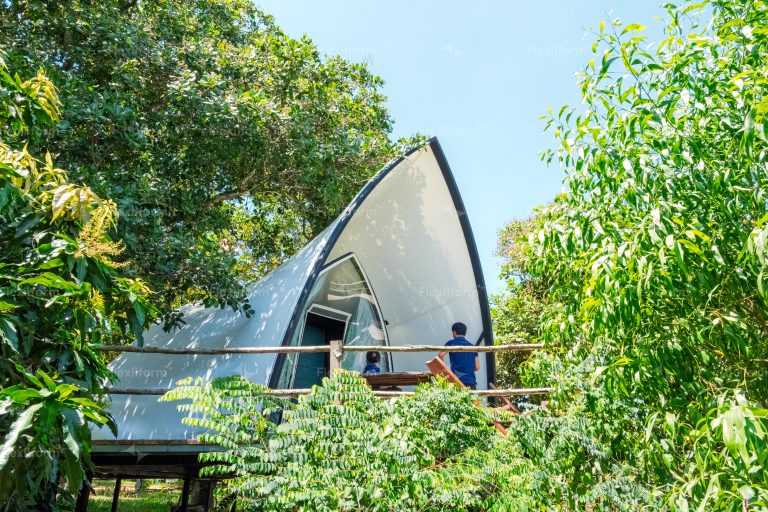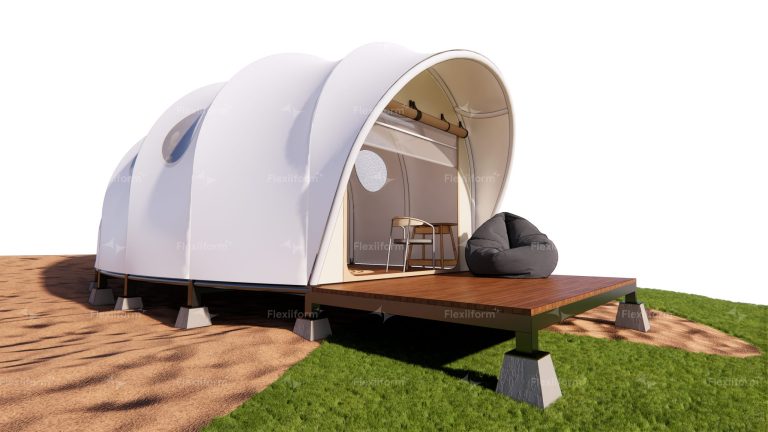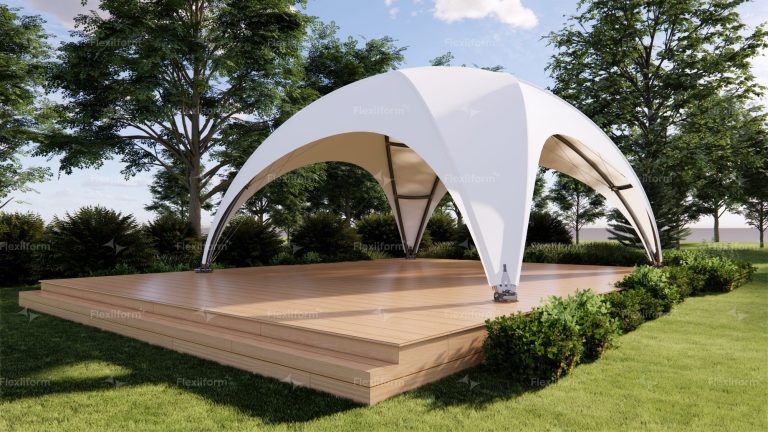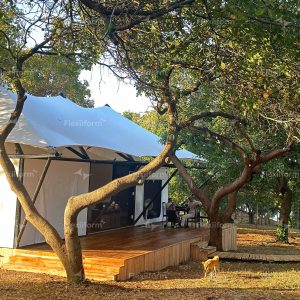
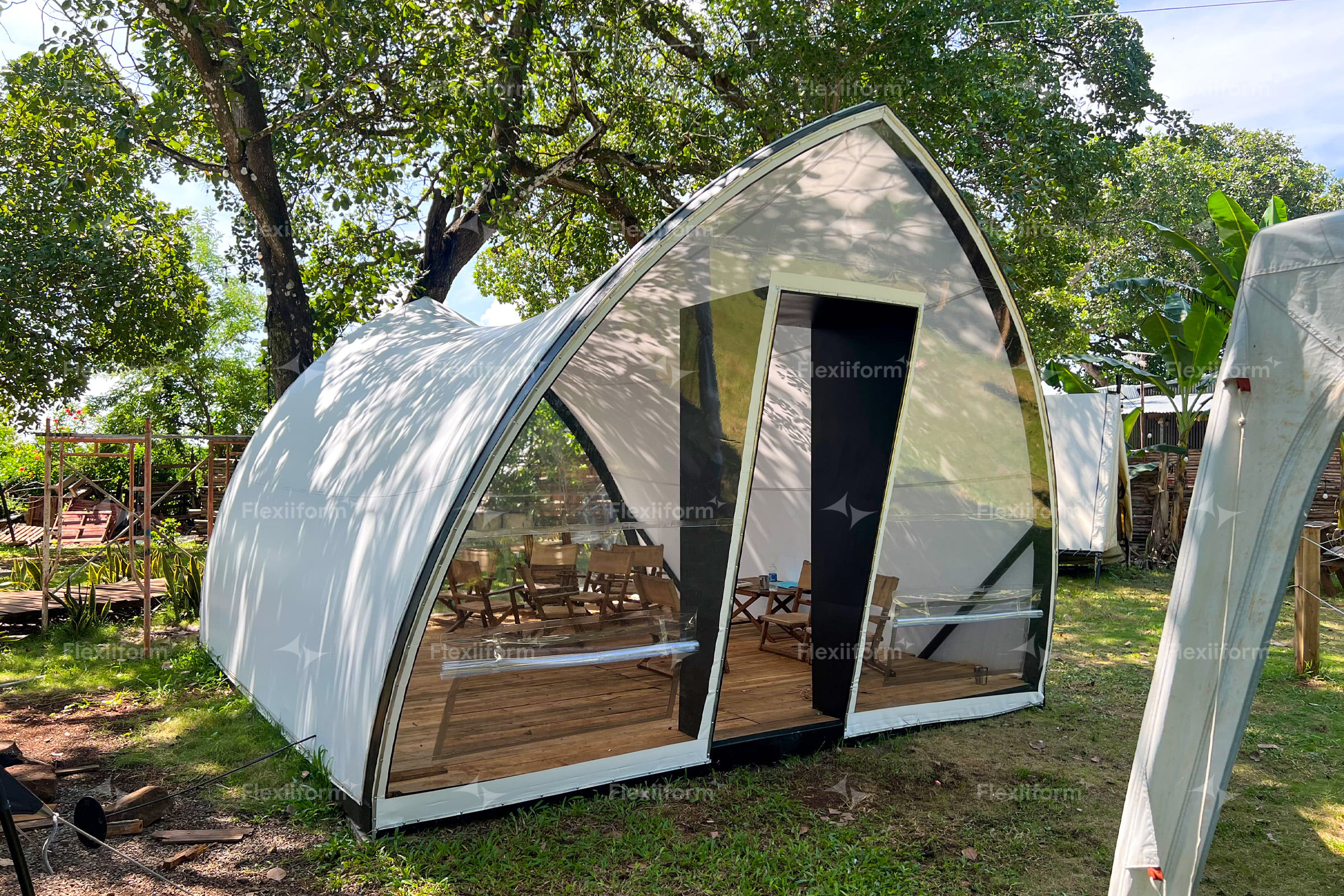
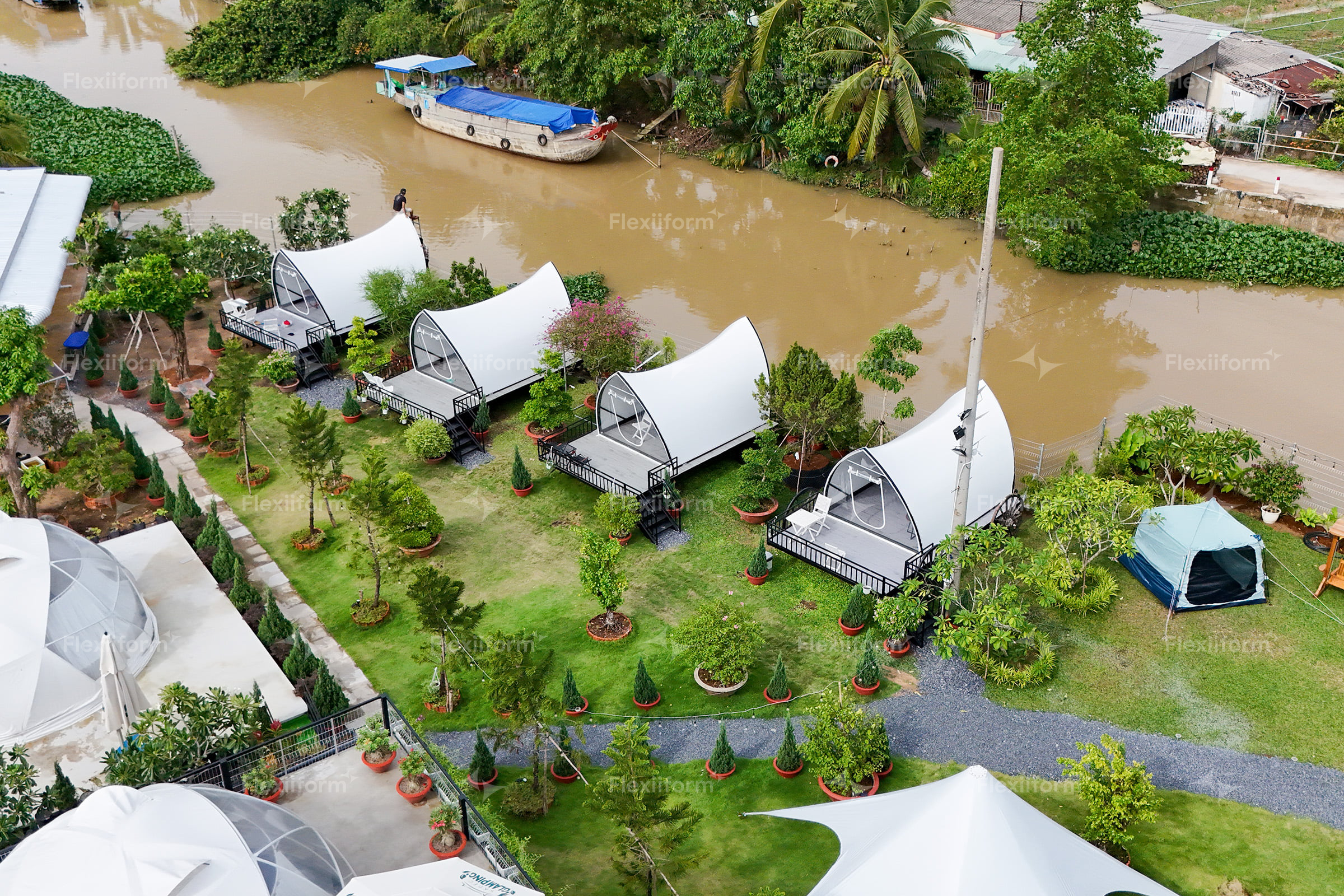
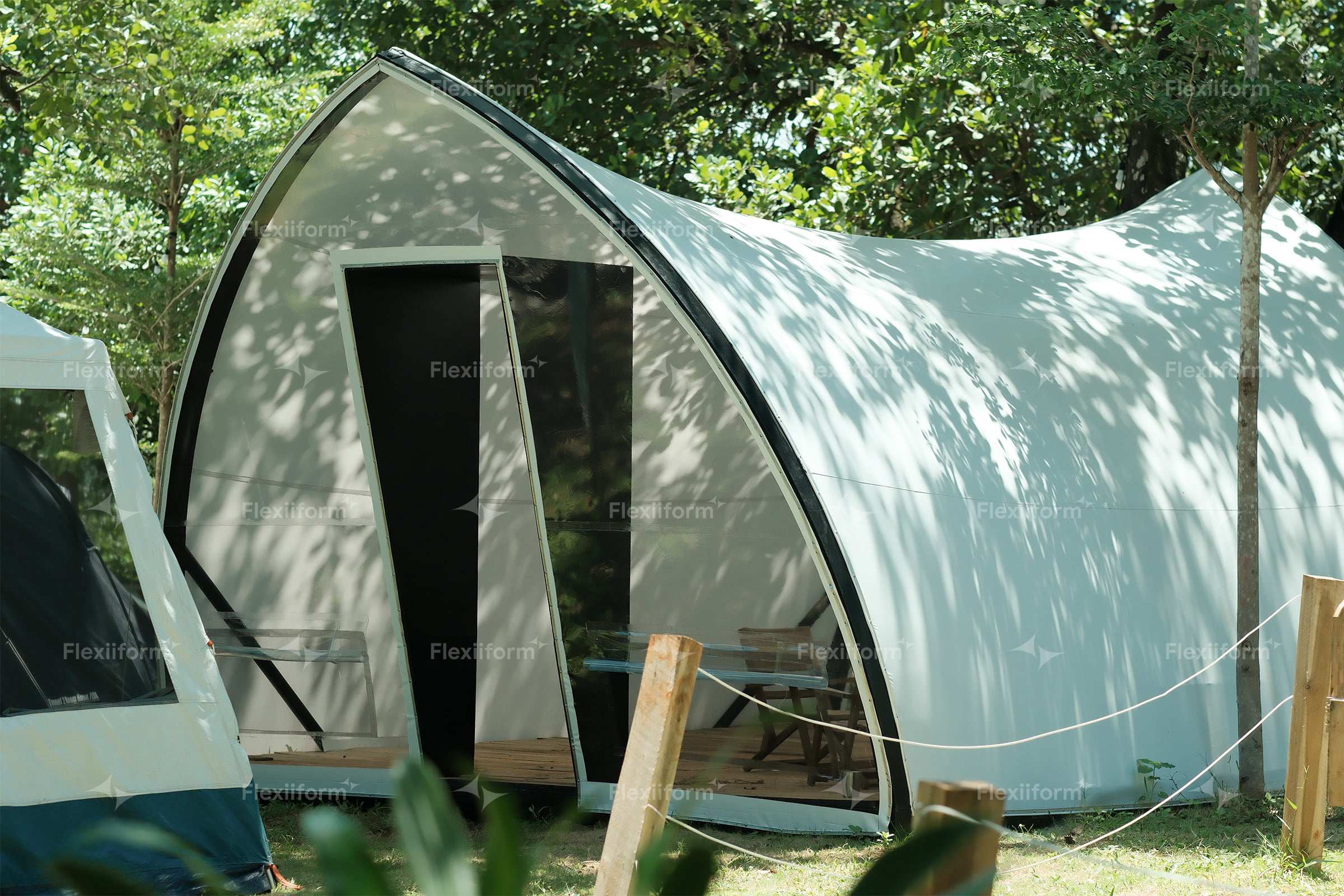
An arch glamping tent is a tent built on curved, arch-shaped frames with a tensioned fabric skin pulled tight over them, giving a room with no centre posts. In glamping it is set up on a fixed floor as a guest room for resorts, homestays and luxury campsites, unlike the small arch or hoop tents people carry for camping. The Arch A Single Layer Tent by Wild Duck Glamping Tent is an arch tent with one layer of fabric: light, compact, installed in about 12 hours by 3 workers, with no foundation digging.
This article explains what an arch tent is, how it differs from a geodesic dome, an A-frame tent and a tipi, what “single layer” means for a resort owner, when a single-layer arch tent is the right choice, and what to prepare before installation.
Arch A Single Layer Tent at a glance
- Structure pointed arch frame at the front, tensioned fabric over the body, no centre posts
- Fabric layers one, serving as both roof and walls
- Size 3 m wide, 2.2 m ceiling, 2.8 m roof peak
- Materials opaque white PVC for roof and walls; clear PVC front and doors with insect mesh
- Doors one 1 x 2.2 m zip door, up to two on request; windows to order
- Installation about 12 hours, 3 workers, no foundation digging
- Service life 5 to 10 years
- Best for mild climates, shaded sites, remote locations, projects that need to open fast
What is an arch tent?
An arch tent takes its name from its main load-bearing parts: frames bent into arches. Loads from the roof travel along the curve down to the two feet of each arch and into the floor, so the tent needs no centre posts and the full width inside is usable. The fabric is stretched between the frames; that tension keeps the surface smooth and taut, and rain runs straight off along the curve.
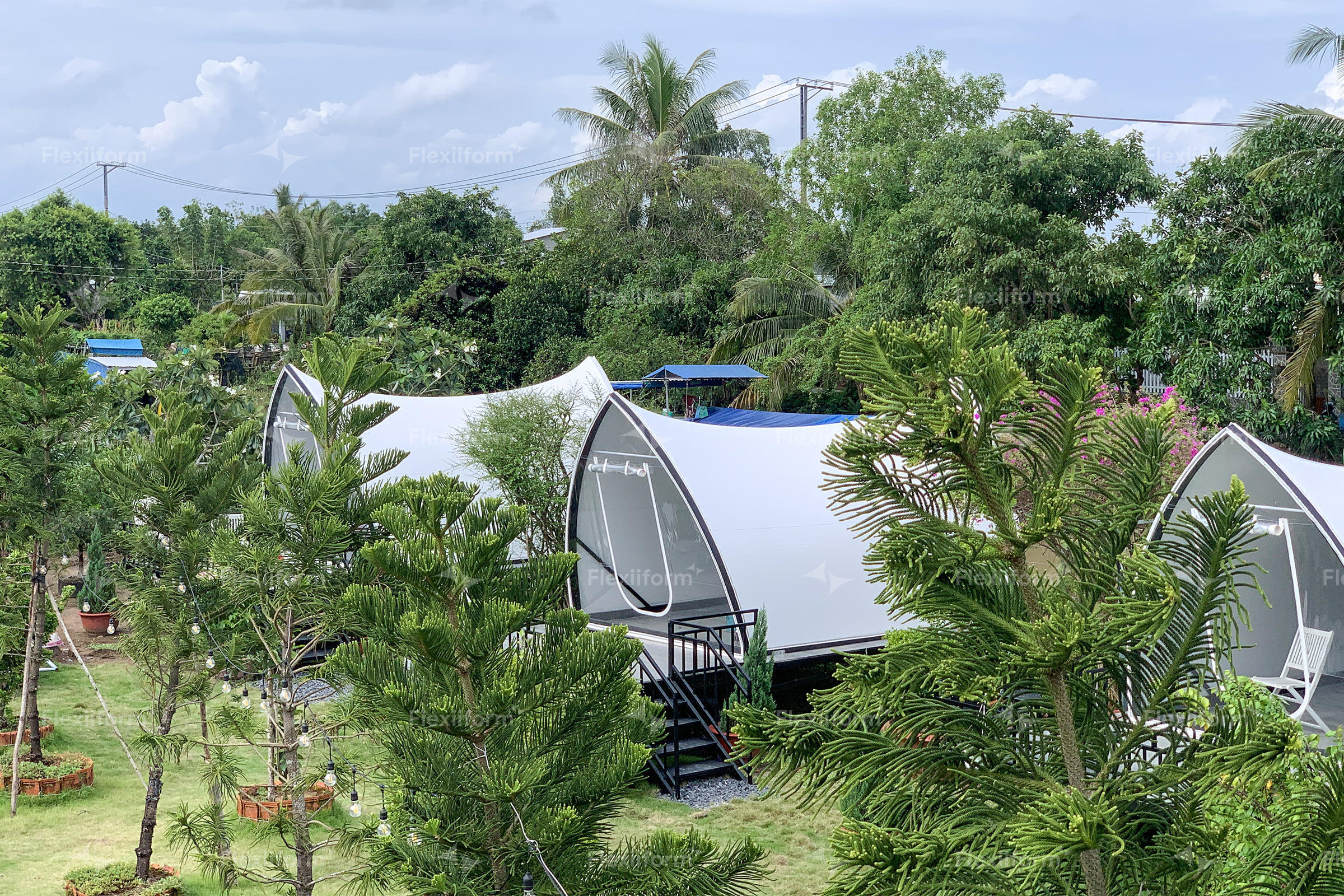
On the Arch A, the front arch is pointed, much like a Gothic church window. The front is a clear wall edged in black, and behind it the white fabric body sweeps back in a curve like a seashell. The shape looks nothing like a typical canvas glamping tent, which helps it become a signature image for the site.
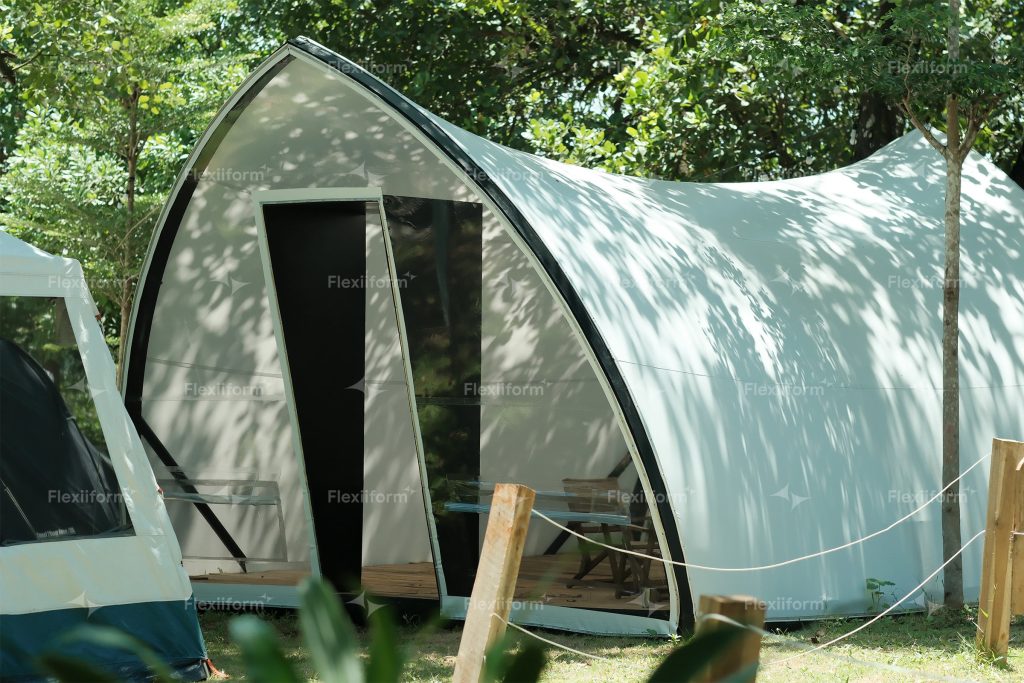
The term “arch tent” covers several things. In camping it usually means a small hoop tent with bent poles; in army and event use it can mean a long arch-frame shelter. This article is about the third kind: an architectural tensile arch tent used as a permanent glamping room.
Arch tent vs geodesic dome, A-frame tent and tipi
| Feature | Arch A arch tent | Geodesic dome | A-frame tent | Tipi |
|---|---|---|---|---|
| Shape | Pointed arch front, curved shell-like body | Half sphere | Two sloping roofs meeting at a ridge | Cone with a gathered peak |
| Frame | Curved arch frames with fabric tensioned along them | Grid of struts forming triangles | Repeated triangle frames along the length | Leaning poles meeting at the top |
| Interior | No centre posts, ceiling rises towards the front | Round, highest at the centre | Narrows towards the ridge, low side walls | Round, low near the walls |
| Strengths | Clear front framing the view, distinctive shape, light and compact | Very familiar on social media, spreads loads evenly | Simple, easy to set out in rows | Classic shape that suits campsites |
| Wild Duck model | Arch A Single Layer and Double-Layer Tents | Steel frame event dome | A Tent | Tipi Tent |
Wild Duck also makes other arch-frame tents with different shapes: the Cocoon Tent (a row of arches forming a long rounded body) and the Spider Tent (two crossed steel arches over a 6 x 6 m room).
What does “single layer” mean?
A single-layer tent, also called a single-wall tent, has one layer of fabric: the outer skin is also the ceiling and walls you see from inside. A double-layer tent adds an outer fabric layer above, separated from the inner one by an air gap. Neither is simply better; it is a trade-off:
- Lighter and more compact: less fabric and frame means a smaller shipment, easier to bring up hills, along rivers or into the mountains where large trucks cannot reach.
- Faster to install: about 12 hours with 3 workers per tent, so the site can welcome guests sooner.
- Lower investment: fewer materials and less labour make it Wild Duck’s most economical arch tent.
- Less insulation than the double-layer version: the sun hits the only layer of fabric directly, so at midday the tent warms up faster. Air conditioning can be fitted, but it works harder than in a double-layer tent.
How a second fabric layer keeps a tent cooler is covered in double layer tent vs single layer.
Inside the Arch A Single Layer Tent
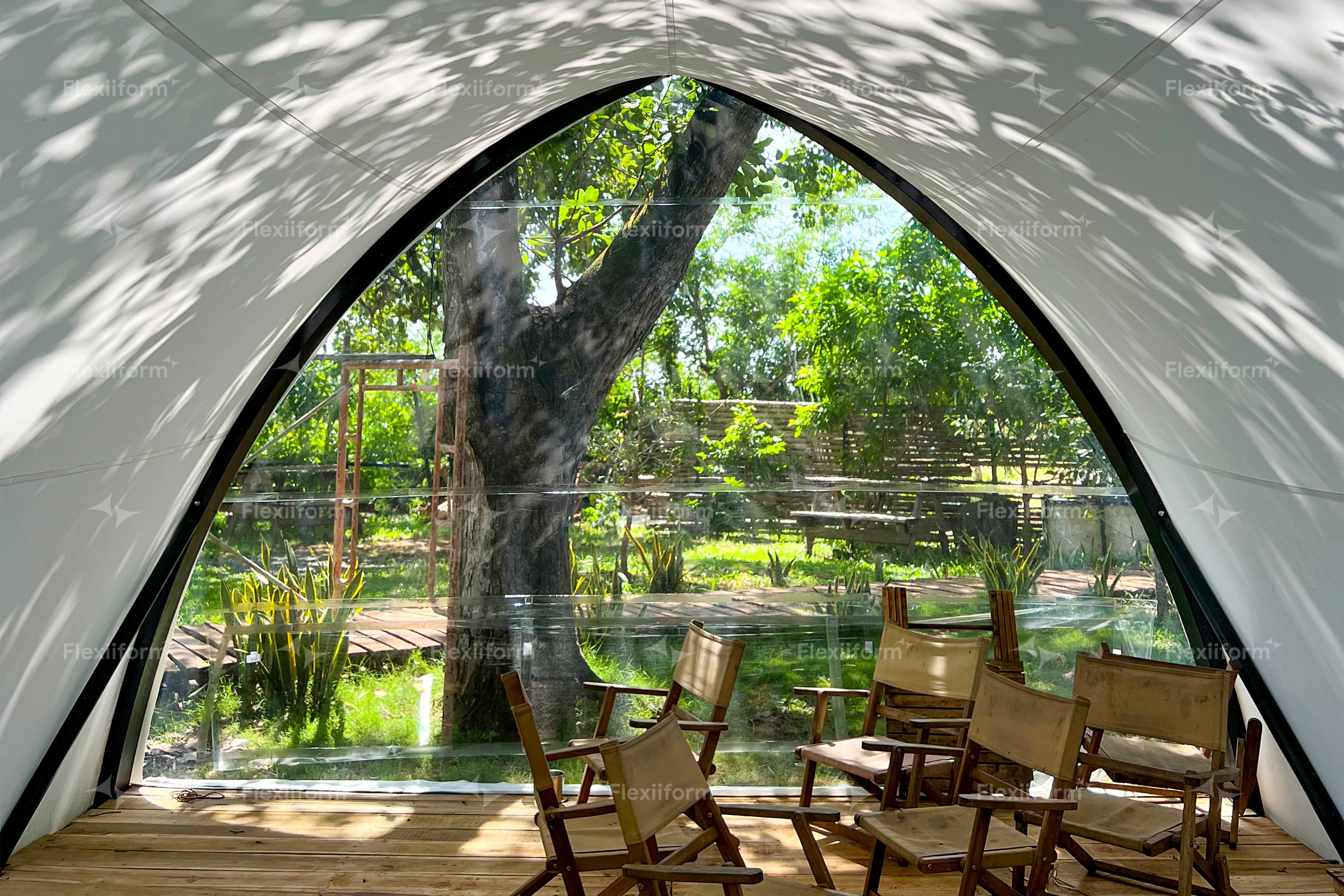
At 3 m wide, with a 2.2 m ceiling and a 2.8 m peak, the tent fits a double bed, a small table and chairs and a clothes rack. The front is clear PVC, so guests lying in bed look straight out at the deck, the garden or the water. The roof and side walls are opaque white PVC, blocking light and keeping the sides private.
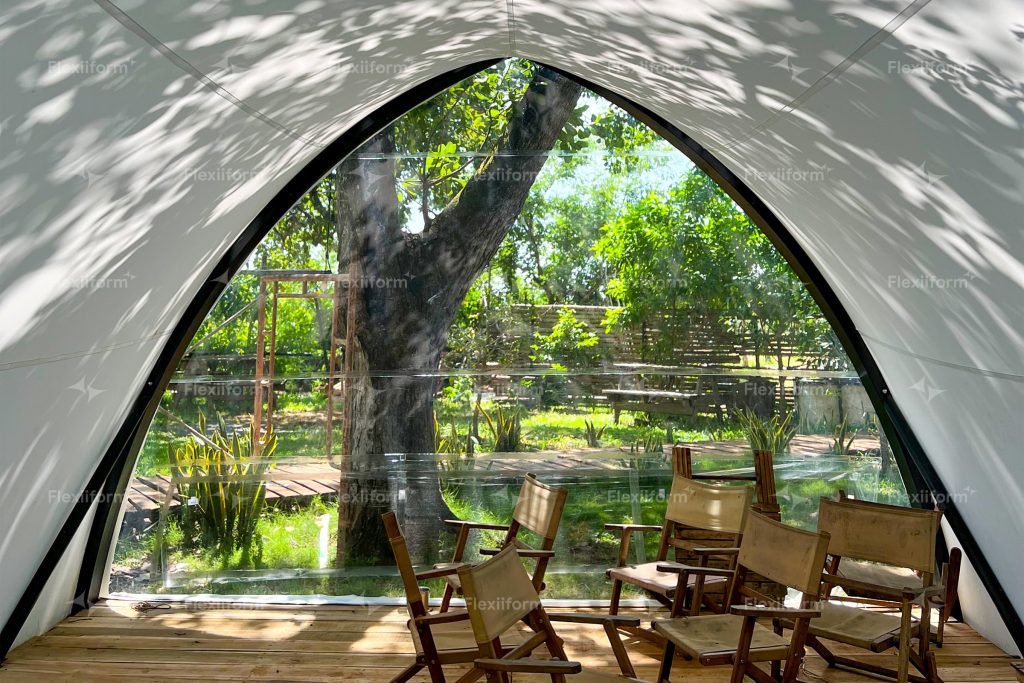
The roof fabric can be removed and the front section swapped for a clear, light-transmitting panel for stargazing. Besides the 100% blackout white fabric, there is a 100% clear option and a frosted option that lets through about 50% of the light. The door closes with a zip and has an insect mesh layer, so it can stay open on warm evenings without mosquitoes.
When should you choose a single-layer arch tent?
- Mild climates: highlands, mountains and places with comfortable daytime temperatures, where the tent does not face harsh sun all year.
- Shaded sites: tents placed under trees get shade at midday, making up for the lighter insulation of a single layer.
- Hard-to-reach locations: narrow roads, steep hills, riverbanks and islands, where a light, compact shipment saves real transport cost.
- Fast openings: new projects that want rooms ready quickly, or owners testing glamping with a few units before scaling up.
- Moderate budgets: standard-tier rooms where many units are needed for a reasonable total investment.
If the site is on a hot coast or lowland, or runs air conditioning almost all year, the Arch A Double-Layer Tent is the better fit. The table below sums up the differences:
| Feature | Arch A Single Layer | Arch A Double-Layer |
|---|---|---|
| Fabric layers | One | Two, with a ventilated air gap between them |
| Size | 3 m wide, 2.2 m ceiling, 2.8 m peak | 5 x 8 m floor, 4 x 5 m room, 2.6 to 3 m ceiling, 4.5 m peak |
| Insulation | Basic | The best of all Wild Duck tents |
| Installation | About 12 hours, 3 workers | Longer than the single layer |
| Best for | Mild climates, remote sites, fast projects | Hot regions, coastal sites, year-round air conditioning |
What to prepare before installing an arch tent
- A flat, solid base: the tent price does not include a foundation. The product page asks the client to prepare a flat concrete base; many resorts set tents on raised timber decks for airflow underneath and to keep damp away. Send Wild Duck your site plan to agree on the base before pouring or building it.
- Orientation: point the clear front at the best view, while avoiding direct afternoon sun if there are no trees to shade it.
- Access and lifting equipment: transport and lifting equipment (scaffolding, trolleys or a crane) are not included. Check the access road to the site first.
- Power, water and air conditioning: plan cabling, the air-conditioner outdoor unit and bathrooms before installation, so nothing has to be cut into the fabric or floor later.
- Spacing between tents: leave paths and private space, since a clear front is easy to see from the next tent.
How much does an arch glamping tent cost?
A reference price for the Arch A Single Layer Tent is listed on its product page. The final price for a project depends on:
- Number of tents
- Size and fabric type (blackout, clear, frosted)
- Number of doors and windows
- Fabric colour to match your brand
- Site location and transport and installation conditions
Send your site location, planned number of tents and a site plan through the Contact page; Wild Duck replies within 24 working hours. You can also compare other glamping tent models.
Frequently asked questions about arch tents
What is an arch tent?
A tent built on curved arch frames with tensioned fabric over them and no centre posts inside. In glamping, arch tents are installed on a fixed floor as guest rooms for resorts and homestays.
Is an arch tent the same as a geodesic dome?
No. A geodesic dome is a half sphere made of many triangles. The Arch A has a pointed arch at the front and a curved shell-like body, built from arch frames with fabric tensioned along them.
Does a single-layer arch tent get hot?
Under strong midday sun, a single-layer tent warms up faster than a double-layer one because it has only one layer of fabric. It suits mild climates or shaded sites best; in places that are hot all year, choose the double-layer version.
Can a single-layer arch tent have air conditioning?
Yes. The fabric roof and walls are closed and the zip door seals, so the tent can be air-conditioned. Plan the outdoor unit position and power supply before installation.
How long does it take to install an Arch A Single Layer Tent?
About 12 hours with 3 workers, with no foundation digging, once the base is ready.
How long does an arch tent last?
5 to 10 years. The PVC fabric is easy to clean and maintenance costs are low.
Can the fabric colour match our brand?
Yes. The tent comes in several sizes and fabric colours to match your site’s identity. Send a request through the Contact page.
Planning a glamping site with arch tents?
Send your site location, planned number of tents and a site plan. Wild Duck will advise on single or double layer, the layout, and quote within 24 working hours.
Get arch tent advice