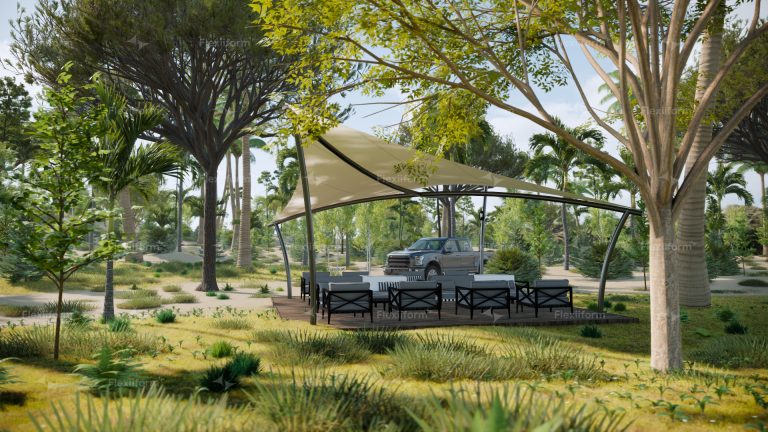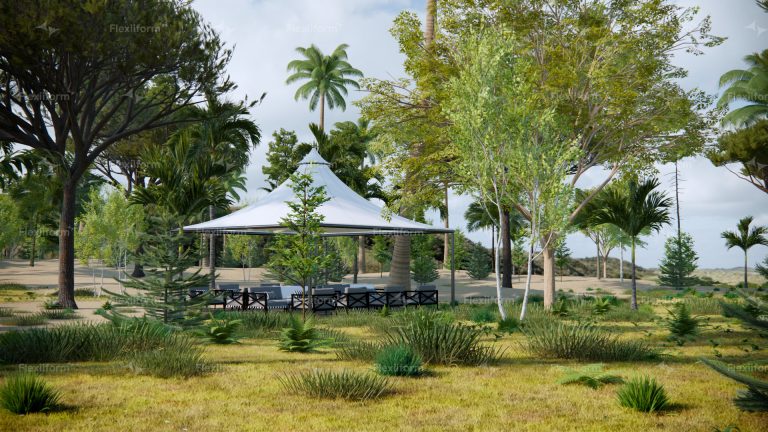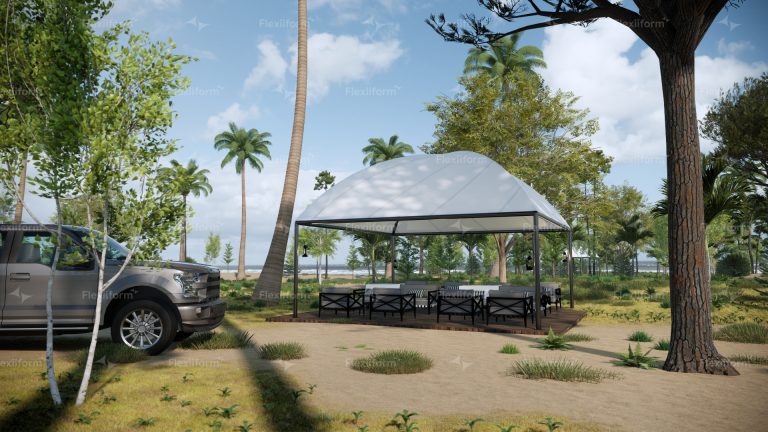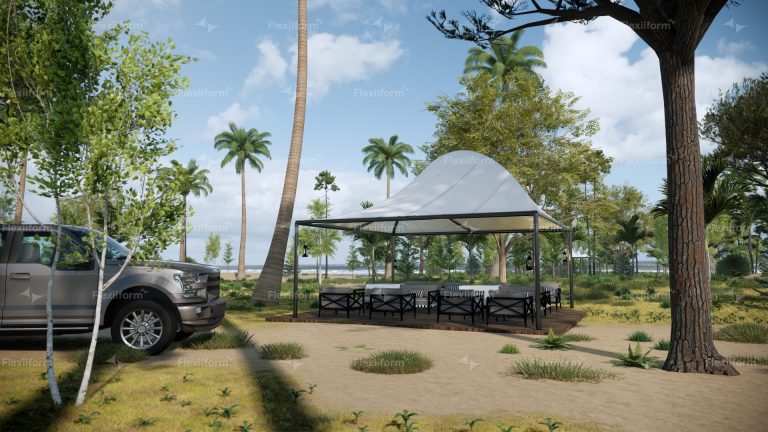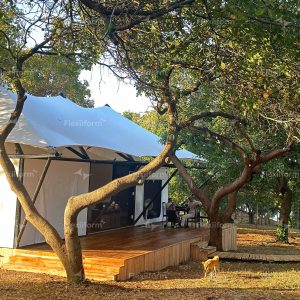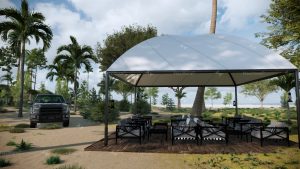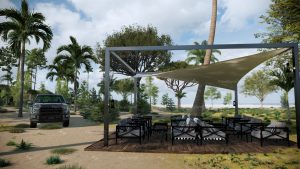
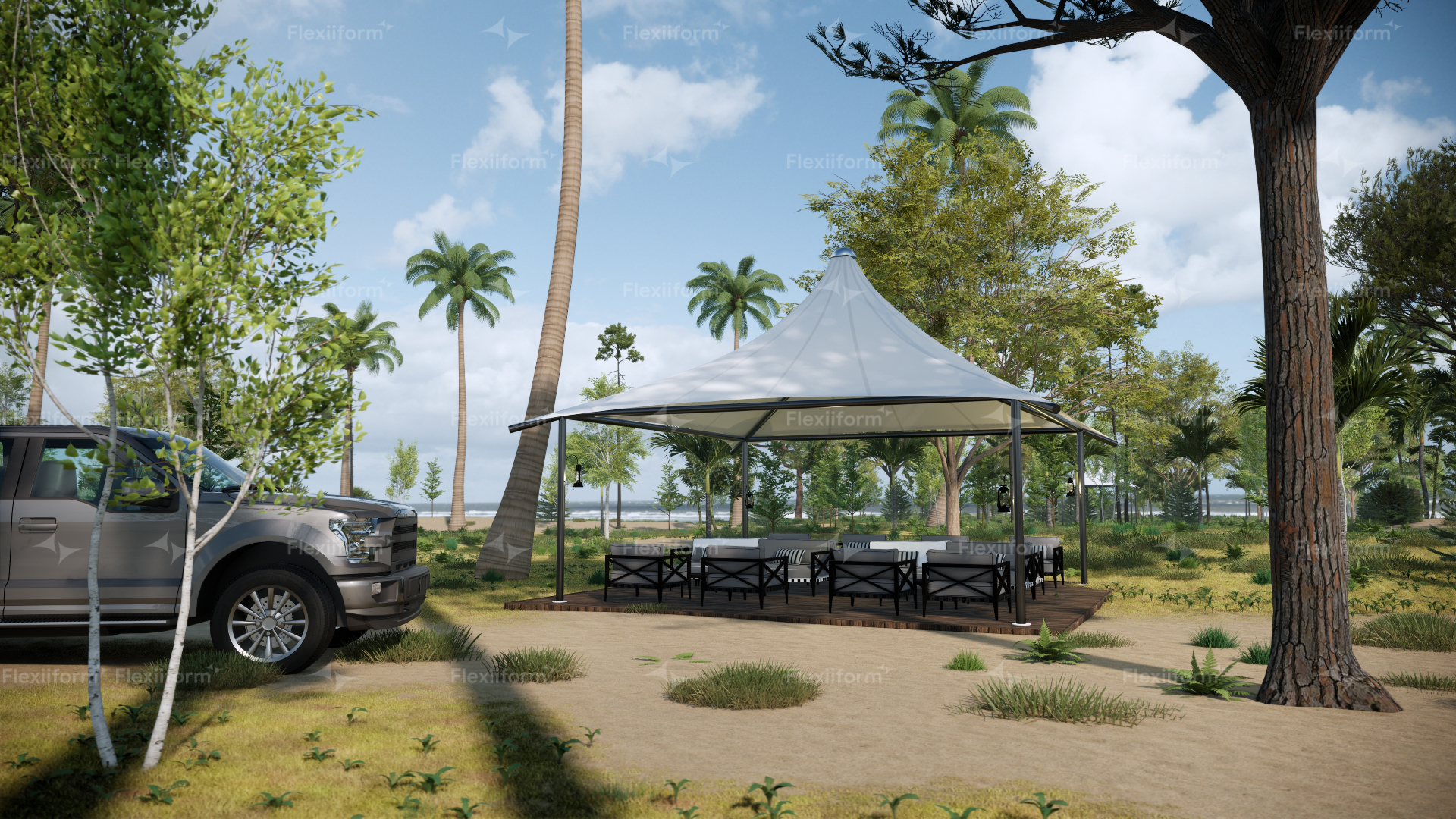
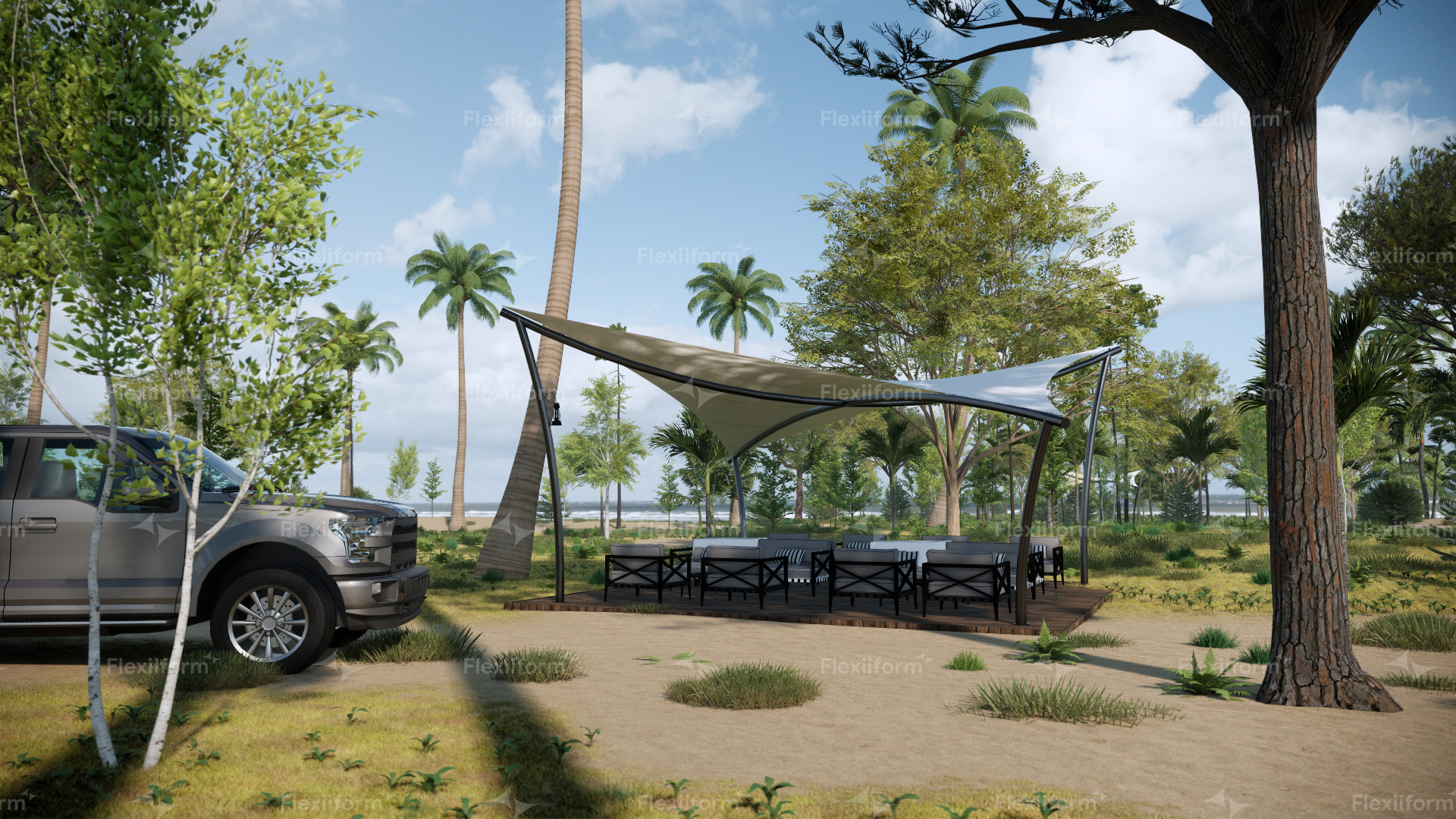
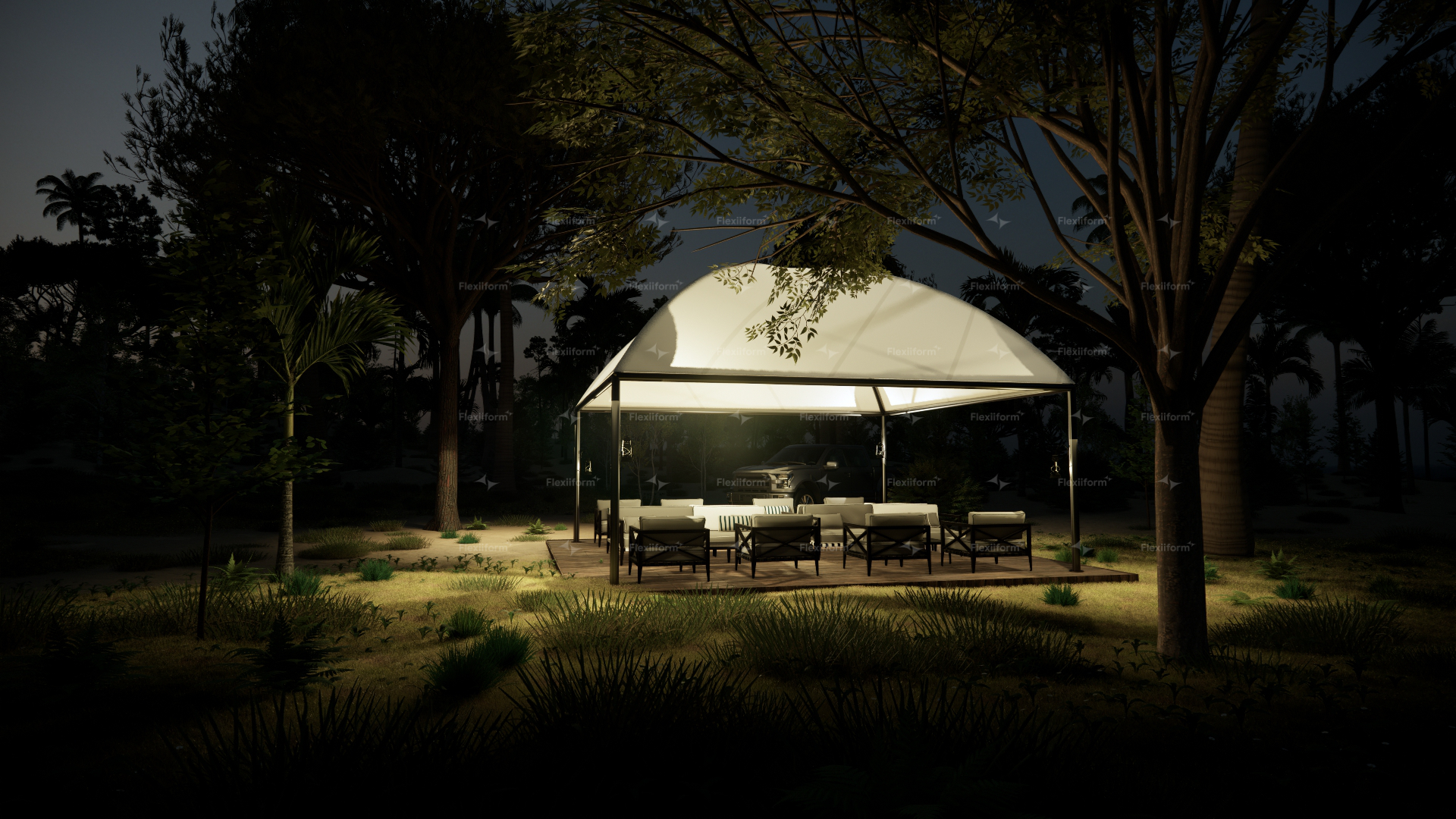
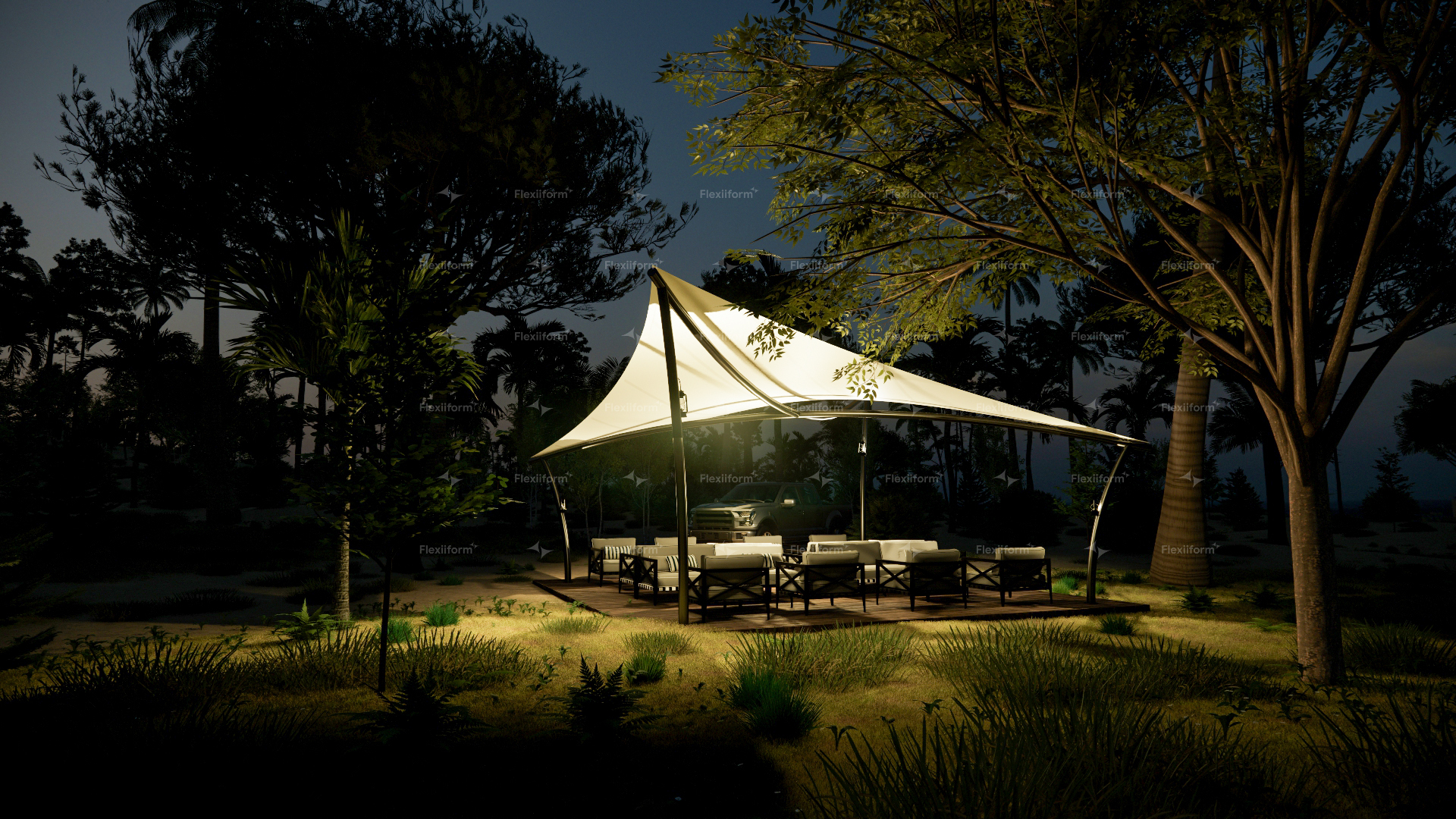
A pergola is an outdoor structure of upright posts that carry beams and cross rafters, forming an open frame that shades a walkway or seating area. The top can be left open as a trellis for climbing plants, or covered with louvres, fabric, polycarbonate, glass or a tensile membrane to keep out sun and rain. Unlike a house or a closed shelter, a pergola is usually open on its sides.
Today the word covers two quite different things: the classic garden trellis overgrown with vines, and the roofed pergola used as an all-weather outdoor room for terraces, cafés and resorts. This guide explains what a pergola is, the main roof types and frame materials, how a pergola differs from a gazebo, a pavilion or a glamping tent, and how to choose one for a hot, rainy climate.
Pergola at a glance
- Definition an outdoor frame of upright posts and cross beams, with an open or covered top
- Word origin Italian “pergola”, from the Latin “pergula” (a projecting eave)
- Main roof types open trellis, aluminium louvres, retractable fabric, polycarbonate or glass, tensile membrane
- Common frame materials timber, wood-plastic composite, steel, aluminium
- Used for gardens, rooftop terraces, cafés, garden restaurants, pool decks, resorts, parks
- Versus a gazebo a pergola is open-sided and its top may be open; a gazebo always has a solid roof
Where does the word “pergola” come from?
“Pergola” is an Italian word that comes from the Latin “pergula”, meaning a projecting eave or a structure jutting out from a building. English borrowed it unchanged. In classic European gardens, a pergola was a row of brick, stone or timber columns carrying timber beams, with grapes, climbing roses or wisteria trained over the top to make a shaded walk.
Most pergolas built today for homes and hospitality have some form of roof, because guests and owners want to use the space when it rains as well as when it is sunny.
Open pergola, roofed pergola and tensile pergola: what is the difference?
| Criteria | Open (trellis) pergola | Roofed pergola | Tensile pergola |
|---|---|---|---|
| Top | Open rafters and slats for climbing plants | Aluminium louvres, retractable fabric, polycarbonate or glass | A membrane tensioned over the frame into a curved surface |
| Rain cover | No | Yes (louvres must be fully closed) | Yes with a closed roof; shade sails mainly give shade |
| Typical frame | Timber, wood-plastic composite, iron | Aluminium, steel | Steel or aluminium |
| Shape | Straight and rectilinear | Flat or gently pitched roof | Peak, dome, wave or sail roofs |
| Most common in | Gardens, balconies, walkways | Rooftop terraces, backyards, villas | Resorts, beach bars, cafés, garden restaurants, parks |
Common pergola roof types
Open trellis
The original pergola: evenly spaced beams and slats, with shade coming from the frame itself and the plants that grow over it. Natural and attractive, but it does not keep out rain, and it only gives real shade once the plants have filled in.
Aluminium louvres
The roof is made of aluminium blades that rotate to control sun and airflow. When fully closed, the blades lock together into a rain-tight roof that drains through gutters in the frame. Many systems are motorised and remote controlled.
Retractable fabric
A fabric cover runs on rails, extending in sun or rain and folding back when you want open sky. It is a common choice for cafés, restaurants and townhouse terraces.
Polycarbonate or glass
Polycarbonate sheets or toughened glass give complete rain cover while letting light through. Under strong sun the space below can heat up unless the panels have a heat-reducing layer.
Tensile membrane
A technical membrane is pulled taut over the frame into a three-dimensional curved surface, such as a peak, dome, wave or sail. The curvature sheds rainwater quickly. This is the roof type behind Wild Duck’s pergolas, explained in more detail below.
Pergola frame materials: timber, composite, steel or aluminium?
- Timber: warm and natural in a garden. Outdoors it needs treatment against rot and insects and regular refinishing to avoid cracking.
- Wood-plastic composite (WPC): looks like timber, warps less, is not attacked by termites and needs less maintenance than natural wood. Widely used for garden trellis pergolas.
- Steel: strong, allows wide spans and curved shapes. It needs galvanising or powder coating against rust, especially near the sea.
- Aluminium: light and rust-free, suited to rooftops and coastal sites; the standard material for louvred roof systems.
How is a pergola different from a gazebo, a pavilion or a glamping tent?
| Structure | Roof | Sides | Purpose |
|---|---|---|---|
| Pergola | Open or covered | Open; curtains or panels can be added | Shade for seating, walkways and dining |
| Gazebo | Always a solid roof, often octagonal or round | Open, often with railings or built-in seats | A viewing shelter and garden focal point |
| Pavilion | Solid roof, usually larger | Open | Shelter for groups, events and dining in parks or resorts |
| Glamping tent | Closed roof | Walls, door and windows | A guest room for overnight stays |
The lines are not absolute. A pergola with a closed peaked roof, such as the Cone Roof Pergola, can work as a gazebo-style shelter; our guide to resort gazebo design compares roof types and placement. If your project needs somewhere for guests to sleep, look at glamping tents instead of a pergola.
What is a tensile pergola?
A tensile pergola is a pergola whose roof is a technical membrane stretched over the frame. Instead of lying flat like an ordinary cover, the membrane is shaped and tensioned in several directions, so the roof holds a distinct curved form.
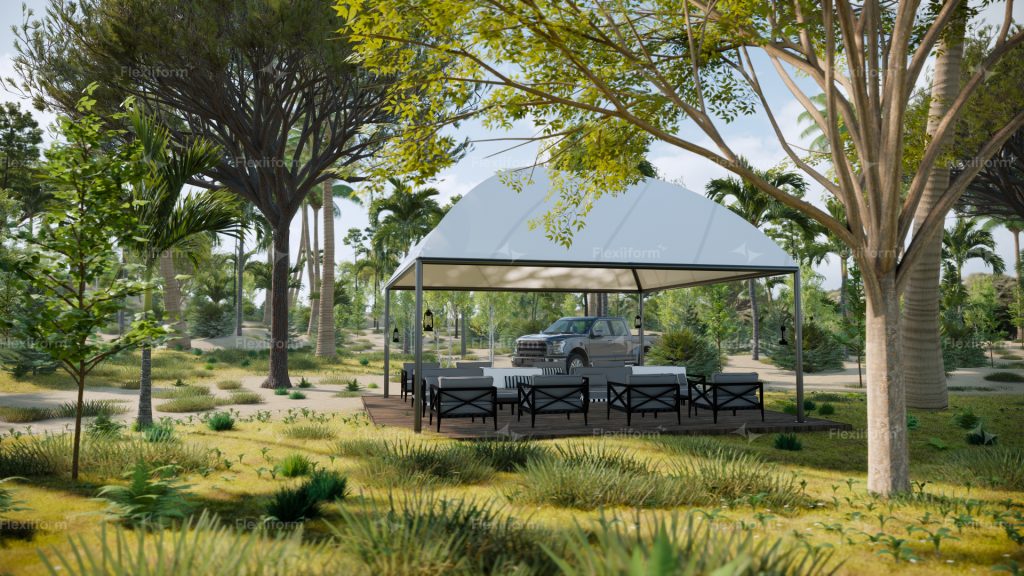
This type of pergola has a few clear advantages:
- Free-form roofs: peaks, domes, waves and sails that are hard to achieve with flat roofing.
- Good drainage: the curved, sloping surface keeps rainwater from pooling.
- Light weight: a membrane weighs far less than metal sheeting or glass, so the frame can be slimmer.
- Strong identity: a light-coloured, sculptural roof easily becomes a landmark and a signature image for a café or resort.
Architectural membranes are typically PVC-coated polyester (often with a PVDF top coat that resists dirt) or PTFE-coated glass fibre. Depending on the membrane, some daylight passes through the roof, so the space below is bright without direct sun. For Wild Duck’s models, the membrane material, membrane colour and frame colour are specified for each project.
Wild Duck’s 7 tensile pergola models
Wild Duck Glamping Tent offers 7 pergolas in the Pergola Modules range. They differ mainly in roof shape:
| Model | Roof shape | Cover | Best for |
|---|---|---|---|
| Flared Peak Pergola | 4 posts, roof sweeping up from four flared corners to a capped peak | Closed roof, sun and rain | Beachfront resorts, beach bars, garden cafés, poolside lounges |
| Wave Roof Pergola | 4 posts, roof shaped into a single wave, high in the middle | Closed roof, sun and rain | Resort arrival areas, pool decks, garden restaurants, small events |
| Dome Roof Pergola | 4 posts, four curved panels meeting at a crown to form a dome | Closed roof, sun and rain | Garden cafés, outdoor restaurants, small parties |
| Low Dome Pergola | 4 posts, softly curved low-profile dome | Closed roof, sun and rain | Rooftop terraces, outdoor bars, lakeside and seaside seating |
| Shade Sail Pergola | Rectangular box frame with a sail tensioned diagonally on top | Shade, with open airflow | Beach bars, pool decks, daytime outdoor cafés |
| Curved Post Sail Pergola | Outward-curving posts tensioning a twisted sail | Shade | Eco resorts, parks, seating among trees |
| Cone Roof Pergola | 4 posts, steep roof rising to a ringed conical peak | Closed roof, sun and rain | Gazebo-style shelters in resorts, parks and campsites |
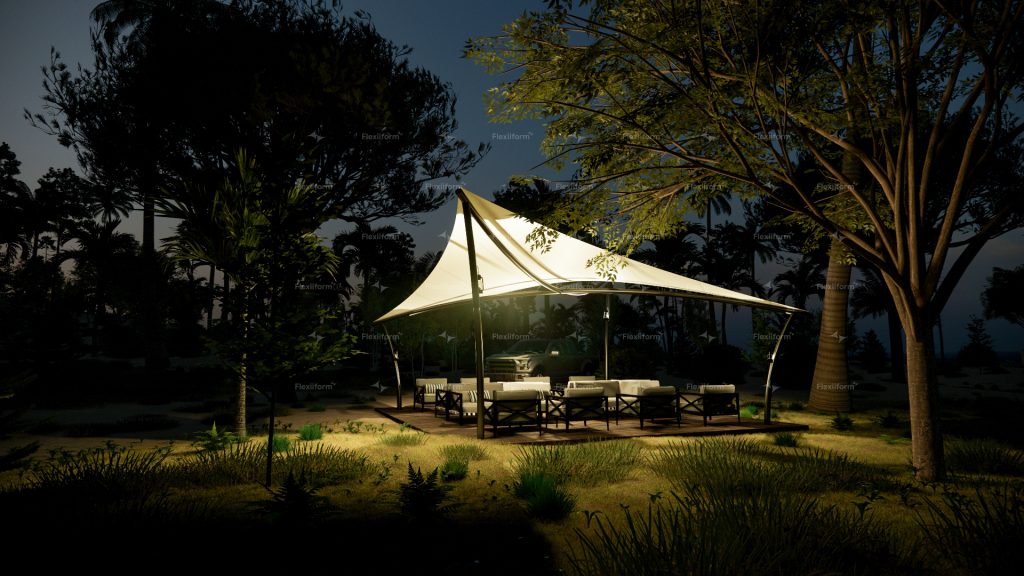
Size, height and materials for each model are specified according to the site plan and intended use, which is why the table gives no dimensions. Send your site plan to receive a detailed specification for your project.
Add-on modules: curtains, partitions and canopies
Wild Duck’s pergolas belong to a modular system, so parts from the Add-on Modules range can be fitted as your needs change:
- Curtain Module: side curtains that close against low sun, wind and driving rain and draw back when you want the pergola open.
- Partition Module: panels that divide the space under the roof, for example into VIP or private dining areas.
- Canopy Module: a membrane cover that extends outward over a walkway, arrival area or the front of the pergola.
- Tensile Roof Module: replaces a worn roof or switches to a different roof shape while keeping the frame.
Where are pergolas used?
- Home gardens and villas: outdoor dining, a tea corner, a planted walkway. See our garden canopy guide.
- Rooftop terraces and balconies: shade for a relaxing area; at height, wind load and anchoring need careful attention.
- Cafés and garden restaurants: more outdoor seats that stay usable when it rains. See our guide to choosing an outdoor cafe canopy.
- Resorts and hotels: poolside lounges, beach bars, arrival areas, outdoor breakfast spaces.
- Parks and campsites: rest shelters and shared gathering spaces.
How to choose the right pergola
- Decide what it must keep out: if you only want dappled shade and greenery, an open trellis is enough. If people must sit there in the rain, choose a closed roof: louvres, fabric, polycarbonate or a tensile membrane.
- Plan for the local weather: heavy tropical downpours call for fast-draining roofs, coastal sites need corrosion-resistant frames and a plan for storm winds, and strong sun calls for a roof that does not trap heat.
- Check the ground and anchoring: concrete slabs, timber decks and garden soil each need a different way of fixing the posts. On a rooftop, check the load capacity of the slab.
- Match the shape to its role: a pergola standing alone in open space is a focal point, so a striking peak or wave roof pays off. Next to an existing building, a low, compact shape usually fits better.
- Think ahead about expansion: if you may later need wind screens, separate zones or an extra canopy, a modular system lets you add them without starting over.
How much does a pergola cost?
There is no single price for a pergola, because the cost depends on:
- Frame size and height
- Frame material (timber, composite, steel, aluminium) and finish
- Roof type: open trellis, louvres, retractable fabric, polycarbonate, glass or tensile membrane, and whether it is motorised
- Foundations and anchoring for the site
- Extras such as curtains, partitions, gutters and lighting
- The number of pergolas in the project and the installation location
For a quote on a Wild Duck tensile pergola, send the size of the area, the number of seats you need to cover and the roof shape you like via the Contact page, or use the quote button on any product page. Wild Duck replies within 24 business hours.
Frequently asked questions about pergolas
What is a pergola?
A pergola is an outdoor structure of upright posts carrying beams and cross rafters, with a top that is either open for climbing plants or covered by a roof. It provides shade for walkways, seating and dining areas in gardens, on terraces, at cafés and in resorts.
Does a pergola keep out rain?
An open trellis pergola does not. A pergola with a closed roof, such as fully closed aluminium louvres, retractable fabric, polycarbonate, glass or a closed tensile membrane roof, does. Shade sail pergolas are mainly for shade.
What is the difference between a pergola and a gazebo?
A gazebo always has a solid roof, is often octagonal or round, and stands alone as a viewing shelter. A pergola is a post-and-beam frame whose top can be open or covered, and it is usually square or rectangular.
Is a tensile membrane roof the same as a fabric cover?
No. An ordinary fabric cover lies or slides across the frame as a flat surface. A tensile membrane is shaped and tensioned in several directions, so it holds a fixed curved form such as a peak, dome, wave or sail, sheds rain quickly and resists sagging.
Does a pergola need foundations?
It depends on the site. A pergola can be anchored to a concrete slab, a timber deck or its own footings in a garden. For Wild Duck’s models, the placement and post anchoring are designed around the actual site plan of each project.
How much does a tensile pergola cost?
The price depends on size, membrane material, roof shape, quantity and add-on modules such as curtains or partitions. Send your details via the Contact page and Wild Duck will quote within 24 business hours.
Need a pergola for a garden, café or resort?
Send the size of the area, the number of seats to cover and the roof shape you like. Wild Duck will suggest a tensile pergola model and quote within 24 business hours.
Get pergola advice